
Interrail: 31,000 km, 27 countries and over 200 trains, Luc's incredible journey
by
Published on 10/17/24, modified on 7/23/26

Inspiration and great deals for your next low-carbon trips



In 2024, Tim traveled from Australia to Perpignan without flying: 195 days, 17 countries, more than 40,000 km traveled by combining trains, buses, ferries, cargo ships, boat-hitchhiking, and hitchhiking. A journey that began with a very simple question (is it still possible to travel very far without taking the plane for granted?) and which took him all the way to a prison in Indonesian Timor, where he faced Russian counterintelligence, and into the heart of a true “boat-hitchhiking” method that he now shares in detail!
Two years later, he did it again—a round trip from Lyon to Sweden in one week—and is already planning a new challenge: reaching Fitz Roy in Patagonia, still without flying…
"I thought I was going on a trip without flying. In reality, I discovered a different way to travel."
Tim is 25 years old; he is an engineer and mountaineer, and is originally from Perpignan and Neuchâtel, Switzerland. Since 2024, he has been exploring a new way to travel: reaching destinations (and even mountain peaks!) without flying, by turning the journey itself into an adventure. Behind his approach, of course, lies a concern for environmental issues that began years ago. But today, that’s no longer what he’s trying to highlight:
"The environment is what sparked my thinking, but I find that the best way to inspire people to travel differently isn't necessarily to explain to them why they should do it. It's about showing them what they can experience by doing it."
"I want to showcase alternative ways of traveling—without any environmental divides—using my own brand of 'crazy bus' humor."

Tim after climbing Mount Inierie, the highest volcano on the island of Flores
So where did this crazy project come from (which he shares on his Instagram account and on LinkedIn)? It all starts with a 6-month end-of-studies internship in New Zealand, in 2023. Aware of the carbon footprint of the trip, Tim wants to consider returning home without flying. But at that point, the idea seems unrealistic to him, and he doesn’t know how to go about it. That’s when he meets Mathilde, who becomes his roommate: she has already crossed the Pacific by boat-hitchhiking. Tim then plans to travel to New Caledonia by boat-hitchhiking, but things don’t go as planned. His employer refuses to postpone the start date of his contract. Reluctantly, he finally has to take a plane.
Once there, he took part in regatta training and looked for sailboats headed for Indonesia. Months passed, his contract ended, he couldn’t find a boat, and civil war was looming. He eventually flew to Australia, where he met someone who was about to set sail on a catamaran.
That is where his great journey officially begins:
"My desire to travel without flying originally stemmed from a fairly simple question: Is it still possible to travel very far without taking flying for granted?"
For 195 days, Tim traveled through 17 countries and more than 40,000 km, using a combination of trains, buses, ferries, cargo ships, boat-hitchhiking, and hitchhiking. Initially, the project had a clear environmental focus: to gain a concrete understanding of the carbon footprint of such a trip (2.6 metric tons of CO2 equivalent in total) and to see what difference it would make to replace a flight with a series of slower modes of transportation.
But experience soon taught him something else:
"When you fly, the trip is often just a brief interlude between two places. You disappear for a few hours and reappear on the other side of the world." Without a plane, the journey itself becomes part of the trip. "You really do cover a lot of ground. You see the scenery change, you meet people you probably would never have met otherwise, you have to improvise, find solutions, and accept that you don't always know what's going to happen tomorrow."
"The goal is no longer just to get somewhere. The journey itself becomes part of the adventure."
The trip began in Australia and ended in Perpignan, in the south of France. Tim didn't have a completely set itinerary in advance: a big part of the adventure was precisely figuring out, as he went along, how to get around without flying.
The major stops along his route:

Tim's Incredible Itinerary Without Flying (map generated on Travel Boast)
In total, Tim traveled by train, bus, ferry, cargo ship, boat-hitchhiking, and hitchhiking, plus numerous local trips to reach the various starting points.
In terms of budget, the average cost of the trip was about 1,000 € per month, all fees included.
"The itinerary wasn't just a series of tickets bought in advance. A significant part of the trip involved figuring out the next mode of transportation: negotiating a spot on a boat, finding a ferry, hitchhiking, figuring out the local rail systems, or completely changing the itinerary when one option didn’t work."
Any specific advice he took away from his time in Russia and Mongolia? For take the Trans-Siberian Railway, it's entirely possible to pay directly on site at the train station for a departure as early as the next day: not all trains are fully booked. Be sure, however, to withdraw cash in Mongolia, since credit cards don't work in Russia.
Our best train deals, straight to your inbox
Hitchhiking by boat is undoubtedly the most unique mode of transportation on this trip: Tim used it for nearly 5,000 km, traveling between Australia and Indonesia, and then through the Cook Strait in New Zealand. Here are his tips, originally shared in a dedicated Facebook group.
Boats are not cars: sailboats are subject to wind seasons, with favorable and unfavorable periods for each crossing. Ideally, the wind—and therefore the waves—should come from behind the sailboat. For a crossing from Indonesia to Australia, for example, the favorable season runs from September to November, although this tends to change due to climate change.
Generally speaking, no. But having them opens up a lot more opportunities: for insurance purposes, a sailboat must have a certain number of experienced crew members on board. Once that quota is met, the captain can take on whoever he wants. Tim recommends the website Sailing for Dummies, which he describes as "the traffic rules for sailboats."
"There's no right answer to that question. It's a matter of perseverance and luck."
Here are a few ideas he shares:
There are three options: a set amount per day, a contribution toward expenses (food, gas), or assistance in kind in exchange for room and board (a form of woofing). Tim only uses the third option: "No money involved = no problem."
By creating a real “sailing resume”: nautical miles, major crossings completed, skills (cooking, DIY, music, languages, photography…), and personal qualities (being a good listener, calm, attentive, responsible). And above all, highlight your passions: there’s nothing better than finding common ground with the crew, with whom you’ll be living 24/7!
Once at sea, safety remains paramount. Tim recommends asking the captain several questions before boarding: the plan and the intended route, who will be on board, how long the captain has been sailing and what crossings he has already made, whether the AIS, VHF, and emergency equipment are in working order, and what repairs still need to be done on the boat ("If he tells you the boat doesn't need repairs, he's lying."), and what he expects in exchange for the seat on board. And for women traveling alone, he still advises extra caution: “There is sometimes inappropriate behavior among sailors (but it’s nothing to worry about too much).”

Left: Climbing Mount Rinkanie, Indonesia’s second-highest volcano. Right: On the ferry between Jakarta and Batam—a great opportunity to meet some wonderful people!
That's all there is to it. A trip of this magnitude isn't just about the itinerary. Tim remembers several pretty crazy stories:
What he takes away from it goes far beyond a mere logistical challenge:
"I came away from this trip feeling very humble. The countries I traveled through aren't 'rich' in the sense that we define it in France, but they are rich in other moral aspects that are just as important."
"I would have taken this trip whether or not I were an environmentalist, because my thirst for adventure and my curiosity outweigh everything else!"
Tim is the type to do it again! Two years later, in August 2026, he sets off once more—this time for a completely different kind of trip. He’s heading to Sweden to see a concert by The Weeknd—still without flying.
"It was an opportunity to introduce slow travel over a less extravagant and more accessible distance, with 5 weeks of vacation per year."
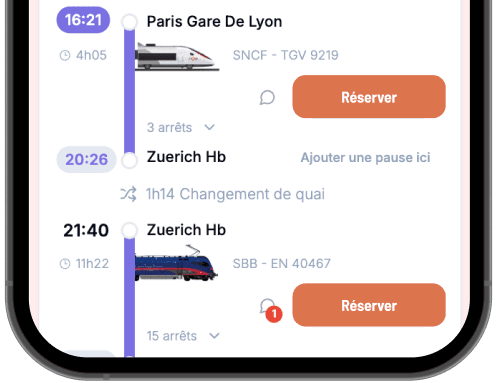
His itinerary, completed in exactly one week:
“I did this in exactly one week, using the HOURRAIL tool!” (We didn't pay him to say that.)
His motivation: to show that, contrary to popular belief, the slow travel Intra-European travel doesn't necessarily mean losing "a day, or even two."
And Tim doesn’t plan to stop there. In December 2026, he’ll set out from France to reach Patagonia without flying, with the goal of climbing Fitz Roy. He sees this as an opportunity to document the various ways to reach Patagonia’s major peaks without flying, and to create what he describes as the world’s first guidebook combining mountaineering and slow travel.
The planned route (still hypothetical at this stage): France, Spain (Canary Islands), Guadeloupe, Brazil, and then Argentina.
"These three trips are ultimately based on the same idea: to stop viewing transportation as merely a means of getting to a destination, but rather as an integral part of the adventure."
"I think we sometimes spend far too much time waiting for the right moment, the right budget, the right itinerary, or the right idea before taking the plunge. Yet the most memorable adventures don’t always start with a perfectly planned itinerary. They often begin with a first step—sometimes a bit absurd—and with the desire to see what lies beyond the horizon. I don’t travel without flying to lecture anyone. I’m simply trying to show that by changing the way we get around, we can also change the way we experience adventure. So if my story can inspire someone to take a train instead of a plane, to set out to explore an unknown place, or simply to dare to pursue that project they’ve been putting off, then that will already be a great success. Because, deep down, the greatest adventure may not be the one that takes us the farthest, but the one we finally decide to embark on."
To follow Tim's adventures, visit his Instagram account @timbizarreadventure and on its YouTube channel !
Issue du monde de la communication et des médias, Sophie est Responsable éditoriale chez HOURRAIL ! depuis août 2024. Elle est notamment derrière le contenu éditorial du site ainsi que La Locomissive (de l'inspiration voyage bas carbone et des bons plans, un jeudi sur deux, gratuitement dans ta boîte mail !).
Convaincue que les changements d’habitude passent par la transformation de nos imaginaires, elle s’attache à montrer qu’il est possible de voyager autrement, de manière plus consciente, plus lente et plus joyeuse. Son objectif : rendre le slow travel accessible à toutes et tous, à travers des astuces, des décryptages et surtout, de nouveaux récits.


