
A single European ticket: Is EU finally set to put an end to the headache of international rail travel?
by
Published on 5/13/26, modified on 7/1/26

Inspiration and great deals for your next low-carbon trips



You may have already experienced this situation. You’re looking for a train route between Paris and Rome on SNCF Connect—but can’t find any satisfactory results. So you open another booking platform, and this time, the trip appears in a matter of seconds, with just one connection in Milan. So why are some train trips still so hard to book? Is this just a problem with SNCF Connect? Or is it a symptom of a European rail system that remains highly fragmented?
This issue is more relevant than ever. For several weeks now, the topic has been at the center of discussions, both in Brussels and in France. After the presentation, on May 13, of the Passenger Package by the European Commission, several NGOs, including the Climate Action Network and Transport & Environment (T&E), welcomed the reform, which they view as a significant step forward for travelers, while noting that it will not resolve all the obstacles currently faced. Meanwhile, the Senate passed the bill on first reading framework law on transportation which requires that all trains operating in France be listed on SNCF Connect, even if they are operated by competitors of the SNCF Group. The bill is currently under review in the National Assembly.
And behind these technical debates lies a very practical question: How can we make booking a train as easy as booking a flight when a trip involves multiple rail companies? To understand the challenges of this reform, we must first look at what currently makes booking international trips difficult.
This is undoubtedly one of the most telling examples. Let's say you want to travel from Paris to Rome by train. In theory, it couldn't be simpler: there are several routes that take you to the Italian capital in about ten hours, with just one connection in Milan.
However, depending on the platform you use (SNCF Connect, Trainline, Rail Europe, or others), you won’t necessarily get the same results. Some will show you the entire trip, while others will display only part of the itinerary—or even no results at all. This doesn’t necessarily mean that one platform is intentionally “hiding” certain trains. Each platform simply has access to a different range of options, depending on the commercial agreements it has with operators and its own technical capabilities.
So the problem isn't always the lack of trains. Very often, the route already exists. What's missing is a simple way to find all the tickets you need and buy them under favorable terms. The same is true of many European destinations, such as Madrid, Naples, Venice, and Seville. It is precisely this paradox that is currently at the heart of debates in Europe and France.
At first glance, this may seem paradoxical. After all, there are many airlines, and they compete with one another. Yet booking a flight with a layover is generally much simpler than booking an equivalent train trip.
One of the main reasons lies in the history of the two sectors. For several decades, air travel has relied on largely interconnected reservation systems. European rail, on the other hand, has historically developed around national networks, each with its own reservation tools and commercial rules.
The gradual opening of the market to competition has further increased this complexity. Platforms must now aggregate offers from numerous operators—such as Trenitalia, Renfe, and European Sleeper—not all of which operate in the same way.
Result: No platform currently lists all European trains. Behind what appears to be a simple research problem lie technical, commercial, and regulatory challenges that are far more complex than they seem.
Psst… If you're looking for a simple way to compare all the options from different companies with just one click, feel free to check it out to our app !
It was precisely to address these challenges that the European Commission presented, on May 13, its The Passenger Package, a wide-ranging reform initiative designed to make train travel across Europe easier.
Among the key measures is the creation of a genuine single ticket for trips purchased in a single transaction, which strengthens passengers’ rights in the event of a missed connection, as well as new obligations for booking platforms and rail operators to facilitate the sale of tickets across multiple operators.
These issues have been highlighted for several years by passenger advocacy groups, NGOs, and some members of the rail industry, who are calling for better coordination of ticket distribution and passenger rights.
👉 We broke down this reform in detail when it was announced. If you’d like to understand exactly how the single ticket works, the new requirements for platforms, or the European timeline, we invite you to read our previous article:

Article
A single European ticket: Is EU finally set to put an end to the headache of international rail travel?
But since then, the debate has taken on a new dimension. Several analyses have been published by the Climate Action Network and the European NGO Transport & Environment (T&E) welcome a reform that constitutes a major step forward for travelers' rights, while acknowledging that it alone will not be enough to resolve all the booking issues currently being faced. This work is now informing ongoing discussions in the European Parliament, as well as in France, where The National Assembly is currently reviewing the framework law on transportation.

According to T&E, the Passenger Package would improve travelers’ rights, but not all trips could be booked as a single ticket on all platforms. As a result, rights would continue to depend, in some cases, on the website used to make the reservation, creating de facto inequality among passengers.
According to T&E, the Passenger Package would improve travelers' rights, but not all trips would be bookable as a single ticket on all platforms. As a result, rights would continue to depend, in some cases, on the website used to make the reservation.
So the real question is no longer just what this reform entails, but whether it will actually make it easier to book train travel. Ultimately, all the current discussions revolve around the same question: How can we make booking a train across multiple countries as easy as booking a connecting flight?
If there's one issue on which there's almost universal agreement, it's this one. Today, when you combine multiple rail companies on a single trip, depending on how you purchased your tickets, you may find yourself without any real protection in the event of a delay.
Let's take an example. You're traveling from Paris to Rome on an SNCF Voyageurs TGV to Milan, then on an Italo train to Rome. If your first train arrives late and you miss your connection, you may currently be forced to buy a new ticket at the last minute—or even pay for a night in a hotel if the next train doesn’t leave until the following day.
With the Passenger Package, when a trip involving multiple operators is purchased as a single ticket In a single transaction (since the single ticket is a type of transportation contract, not a new booking platform), travelers would benefit from new, harmonized rights throughout the European Union. In particular, if they miss a connection through no fault of their own, they could be rerouted at no additional cost, obtain a refund or compensation, as appropriate, and receive assistance (meals, refreshments, or lodging, if necessary).
Transport & Environment even refers to a "a major step forward in protecting travelers' rights". The organization notes that these new protections would apply to both international and domestic trips involving multiple operators.
In other words, The reform is not only intended to simplify the booking process; it also aims to restore travelers' confidence. who are still hesitant to take multiple connecting flights.
Today
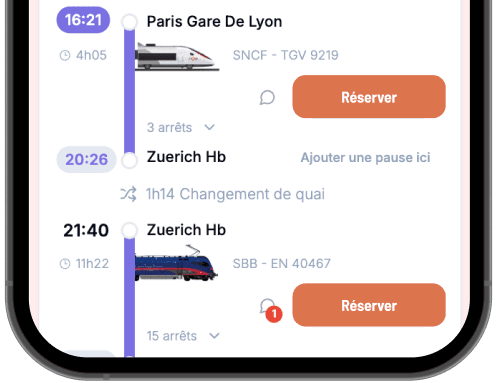
You can already travel from Paris to Rome with just one connection in Milan. However, depending on the platform you use and the agreements between operators, it can be difficult to book the entire trip in one go. Sometimes the trip is also split into several separate tickets.
If your first train is delayed and you miss your connection, you may have to buy a new ticket at the current fare—or even pay for a night's stay at a hotel out of your own pocket.
With the European reform
If that same trip can be purchased as a single ticket, you would be covered by comprehensive protection: rebooking on the next available train, local accommodations if the next train doesn't depart until the following day, or a refund or compensation depending on the situation.
The main challenge
However, a platform must actually be able to sell this trip as a single ticket. This is precisely the point at the center of the current debate.
This is where opinions begin to diverge. In their analyses published in late June, Climate Action Network and Transport & Environment both welcome the progress proposed by the European Commission. The former refers to a “Great news for passengers”, while the second describes the Passenger Package as “a major step forward for travelers’ rights”.
But both organizations also believe that these new rights are likely to benefit only a limited number of travelers. Why? Because these protections would apply only to trips that can be purchased as a single ticket. However, for that to happen, a platform must be able to sell the entire trip in a single transaction.
And this is where the two organizations identify a weakness in the text. The European Commission plans to require dominant platforms, such as SNCF Connect in France, to display or sell tickets from competing operators when their trains depart from or arrive in the country in question. This measure would, for example, increase the visibility of several new routes operated by Trenitalia, Renfe, or European Sleeper.
However, according to Climate Action Network, this would not be enough to make it easy to book certain trips with connections to Spain or Italy. A Paris-Rome trip via Milan or a Paris-Madrid trip via Barcelona could therefore remain difficult to purchase as a single ticket, since part of the journey takes place entirely abroad.
In other words, the reform would significantly improve the situation, but without resolving every possible scenario. This choice is no accident. The European Commission has chosen to focus these new obligations on trains departing from or arriving in the country where the hub is located. This is one way to limit the constraints imposed on national distributors, but it is also a scope that Climate Action Network and T&E now consider too restrictive to truly facilitate long-distance travel within Europe.
To support their analyses, Climate Action Network and T&E have each published several studies in recent weeks.
At the European level, T&E estimates that, even if the Commission's proposals were adopted as is, 43% of rail alternatives to the 30 major European air routes would remain impossible or difficult to book as a single ticket on the main websites of rail operators. In other words, nearly one in every two trips would still not allow travelers to fully benefit from the new rights provided for in the reform. It is barely better than the current situation, as shown in the following graph.

Even after the reform proposed by the European Commission, T&E estimates that 43% of the major international rail routes studied would still be impossible or difficult to book as a single ticket. Source: Transport & Environment, 2026.
The consequences can be very tangible. According to T&E’s calculations, missing an international connection results, on average, in an increase of 55% of the cost of the trip, that is, An additional 86 € on average, not to mention a possible night in a hotel. The organization cites, in particular, the case of a traveler traveling from Seville to Paris who was forced to pay €69 for a new ticket between Madrid and Barcelona, then 50 € for one night at a hotel, due to a lack of protection in the event of a missed connection.
Climate Action Network, for its part, focused more specifically on travelers departing from France. Its analysis concludes that The reform would make certain routes clearly visible on SNCF Connect (such as Paris–Berlin on the European Sleeper, Paris–Marseille on Trenitalia, or Marseille–Madrid on Renfe), but that it would not change anything for the main destinations requiring a connection, such as Rome, Naples, Venice, or Madrid.
Since the presentation of the Passenger Package With the European Commission's involvement, the debate is no longer confined to Brussels. In France, too, the issue is gaining momentum. The Senate recently discussed electronic ticketing in public transportation, while members of the National Assembly are currently reviewing the framework bill on transportation.
Among the many measures under discussion is an issue that may seem very technical, but which could have tangible consequences for millions of travelers: Should certain booking platforms be required to sell more tickets from competing airlines?
The goal is clear: to make it easier for travelers to access the full range of available rail services without having to search multiple websites. In this regard, the French proposal is in line with the European Commission’s objectives. However, the details differ in several respects, particularly regarding the scope of the obligations that would be imposed on the platforms.
The reason SNCF Connect comes up so often in discussions is that it is currently the leading train booking platform in France. According to the Transportation Regulatory Authority, in 2023 the company's revenue was five times that of its main competitor, Trainline. According to AFP, SNCF Connect reportedly sells 85% of train tickets online in France. Organizations that support greater openness therefore believe that making more operators visible would make it easier for a large number of passengers to use the train.
In practical terms, if the legislation were adopted, SNCF Connect might be required to offer more tickets from competing companies—such as Trenitalia, Renfe, or European Sleeper—when their trains operate on French territory.

An AVE train operated by the Spanish company Renfe
However, this does not mean that all European trips will automatically become bookable on SNCF Connect. As we saw earlier, several destinations requiring a connection abroad may still be excluded from this system.
However, this view is not universally shared. According to internal documents that have been revealed by BFM Business, the SNCF Group believes that opening SNCF Connect to competing operators could accelerate the loss of market share in its TGV business. In the scenario analyzed by the company, This would represent a shortfall of up to 320 million euros in revenue over the first two years following the platform's launch. The company also points out that the commissions earned on the sale of competing tickets would not offset these losses. The company has not disclosed the raw data used to perform these calculations, it is therefore not possible to verify these estimates and conclusions.
For SNCF Voyageurs, the issue is therefore not limited to ticket sales. Today, the most profitable routes help finance other, less profitable services. A loss of market share on these routes could therefore, according to the company, undermine this economic balance. According to the Transport Regulatory Authority, the decline in service to intermediate cities began well before the market was opened to competition. The agency believes this is primarily due to excessively high tolls on these routes, which prevent them from being profitable.
Beyond the numbers, the incumbent operators—which are members of the European Rail Community (CER)—are making a broader argument. They believe that requiring a company to sell its competitors' products would constitute an unprecedented intervention in the sector.
The organization's executive director, Alberto Mazzola, summarizes this position as follows: "I don't know of any case where someone is forced to sell a competitor's product." Imagine if Lufthansa were forced to sell Ryanair tickets. "
For these stakeholders, the priorities should focus first and foremost on expanding rail service and infrastructure rather than on new distribution requirements.
On the other hand, SNCF Voyageurs’ competitors naturally see things differently. The French Rail Association (AFRA), which represents several new operators, disputes in particular the economic estimates put forward by the SNCF group. According to AFRA, greater visibility for the various companies on the major booking platforms would not merely redistribute existing passengers: It could also attract new customers to the train.
The association believes that there is currently significant demand for more rail connections and that new entrants are helping to expand the available options, with potential benefits not only for passengers but also for infrastructure managers.
Environmental NGOs, too, advocate a different approach. For Climate Action Network and T&E, the issue goes beyond competition among operators. Their primary goal is to make it easier for passengers to transfer from the plane to the train. They therefore recommend going beyond the current proposal by extending distribution requirements to major European routes that require a connection, so that more travelers can benefit from a true single ticket.
At this point, nothing has been finalized yet. At the European level, the Passenger Package must now be reviewed and negotiated by the European Parliament and the Council of the European Union before it can be adopted. In France, the draft framework law on transportation is also continuing through the legislative process.
It is therefore still too early to know which measures will ultimately be adopted. However, there seems to be a consensus on one thing: ticket reservations have become a major issue for the development of rail travel in Europe.

German train operated by Deutsche Bahn
For a long time, debates about European rail have focused primarily on infrastructure, new lines, and opening the sector to competition. Perhaps the main challenge facing European rail is no longer just to run more trains, but also to make it easy for passengers to use the ones that already exist.
Responses still vary depending on the stakeholder, but everyone now agrees on one thing: simplifying the booking process has become a key factor in making train travel more attractive compared to air travel.
The Passenger Package is one of the most significant European railway reforms of recent years. Its goal: to make it easier to book train trips and to better protect travelers in the event of a missed connection.
But several organizations, such as Climate Action Network and Transport & Environment, believe the text could go further. According to them, some long-distance international routes—particularly to Italy or Spain—remain difficult to book as a single ticket.
At the same time, France is also considering a reform of the distribution of train tickets, which could require certain platforms, such as SNCF Connect, to display more trains operated by competing companies.
Nothing has been definitively adopted yet. Debates will continue in the coming months in both the European Parliament and the French Parliament.
The coming months will be decisive. At the European level, the Passenger Package will now be reviewed by the European Parliament and the Council of the European Union. Both institutions will be able to amend the Commission's proposal before beginning negotiations on a joint text.
In France, the draft framework law on transportation is also moving forward through the legislative process. In particular, the discussions could clarify the obligations that will eventually apply to the major rail booking platforms.
In other words, the rules that will govern international ticket reservations in the future are still far from being finalized. As always, we’ll be following these discussions closely and will keep you updated on how they’ll affect travelers!
To make sure you don't miss a thing, feel free to subscribe to La Locomissive, our bimonthly newsletter:
Our best train deals, straight to your inbox
Issue du monde de la communication et des médias, Sophie est Responsable éditoriale chez HOURRAIL ! depuis août 2024. Elle est notamment derrière le contenu éditorial du site ainsi que La Locomissive (de l'inspiration voyage bas carbone et des bons plans, un jeudi sur deux, gratuitement dans ta boîte mail !).
Convaincue que les changements d’habitude passent par la transformation de nos imaginaires, elle s’attache à montrer qu’il est possible de voyager autrement, de manière plus consciente, plus lente et plus joyeuse. Son objectif : rendre le slow travel accessible à toutes et tous, à travers des astuces, des décryptages et surtout, de nouveaux récits.


