
New Aquitaine by Train: A 7-Day Car-Free Itinerary
by
Published on 7/3/27

Inspiration and great deals for your next low-carbon trips



Searching for Paris-Rome on SNCF Connect and having the impression that the train doesn't exist, multiplying tickets on several sites, crossing your fingers when a connection in Milan, Barcelona or Mannheim is a little tight... If you've ever tried to travel by train across Europe, you're probably familiar with this headache.
We told you about it in our article on the latest report by the Climate Action Network But it's not just the lack of rail lines that hinders travellers. Often, routes already exist, but are difficult to find, book or secure when they involve several rail companies.
And it's precisely these blockages that the European Commission now wants to tackle head-on. On May 13, 2026, Brussels presented an extensive "Passenger Package" to simplify European rail travel This ambitious reform could transform the international train experience in Europe!
But behind the promising announcements, a political, technical and regulatory battle is already shaping up between European institutions, booking platforms and incumbent rail operators. We explain everything.
For several years now, passenger associations and NGOs have been regularly denouncing the difficulties of booking international trains. Unavailability of routes, tickets that cannot be combined or lack of guarantees in the event of a missed connection These obstacles make rail travel across Europe extremely difficult.

Article
Why traveling by train to Europe from France remains so complicated
Against this backdrop, on May 13, 2026, the European Commission presented an extensive "Passenger Package a proposed regulatory package designed to simplify international travel and strengthen travelers' rights.
At the heart of this reform lies a simple idea: "one journey, one ticket. The aim is to enable travellers to buy a one-way ticket covering several rail operators more easily This also applies when a journey combines several transport contracts purchased in a single transaction.
Today, this type of itinerary can quickly become very complex to book. Some platforms do not distribute tickets from certain foreign operators While others display only part of the available itineraries. As a result, many feasible journeys seem invisible to travellers. A trip like Paris-Madrid, for example, may require several separate searches, even though it can be done with just one connection in Barcelona.
The European Commission therefore wishes to oblige operators and platforms to facilitate access to these multi-operator routes. In concrete terms, travelers should be able to search, compare and buy routes combining several airlines in a single transaction, via the platform of their choice.
The reform also provides for a significant strengthening of passenger rights. When a multi-operator journey is purchased in the form of a one-way ticket, the passenger would benefit from a complete protection in the event of a missed connection : possibility of boarding the next train, assistance, re-routing, reimbursement or compensation depending on the situation.
This is a potentially major change for international rail travel in Europe. Today, when a traveler buys several separate tickets from different companies, he can find himself without any protection if his first train is delayed. In some cases, this means having to buy a new ticket at the last minute, sometimes at very high prices.
The text also provides for prevent platforms and sellers from artificially segmenting certain journeys into several separate tickets to avoid passenger rights obligations. In concrete terms, when a trip can be sold in the form of a one-way ticket, industry players will no longer be able to circumvent passenger protections by splitting the booking into several separate transactions.
Finally, the Commission wishes to further harmonize claims procedures to avoid passengers having to identify the responsible operator themselves in the event of a problem on a route involving several companies.
The text also introduces new obligations for booking platforms and rail operators. In particular, companies will have to negotiate access to their distribution systems with platforms that request it, under conditions deemed "fair, reasonable and non-discriminatory".
The stated aim is to make the European rail market more transparent and accessible. The text also provides for more neutral bid presentation rules. In particular, the regulations provide for the possibility of ranking routes according to several criteria, including price, travel time and greenhouse gas emissions whenever possible.

Fictitious illustration of a rail reservation platform integrating several competing operators in a unified display.
It also sets out precise deadlines to prevent negotiations from dragging on for too long. In the event of deadlock, national regulators could even be called upon to impose the terms of an agreement between the parties.
The Commission also wishes to more harmonized sales opening with an obligation to provide tickets at least five months before train departure. This measure could make it easier to organize long-haul international travel, which is often complicated by the late opening of bookings by different operators and countries.
Passengers should also have a clearly identified contact person at the time of purchase to handle any complaints they may have about their journey.
This reform could also strengthening the role of independent platforms like Trainline or Omio in the European rail ecosystem.
Today, the market remains highly fragmented and largely dependent on the distribution systems of incumbent operators. By imposing greater openness and interoperability, the European Commission seems intent on facilitating the emergence of platforms capable of more easily aggregating the offerings of several European companies.
For travelers, this could make booking international trips more like what already exists in the airline industry.
If the text is adopted in an ambitious version, booking an international train journey could become much simpler.
More itineraries could become visible on rail booking platforms, with better integration of the various European companies and connecting routes. For passengers, this could gradually reduce the current fragmentation of European railways.
Journeys that are difficult to reconstruct today, such as Paris-Rome, Paris-Madrid or Paris-Prague, could become much easier. more accessible to the general public.
Passengers could also benefit from much stronger guarantees in the event of delays or missed connections, including on routes involving several operators.
A development that would bring the train even closer to standards already known in the airline industry for connecting flights and boost confidence in long-distance travel in Europe.

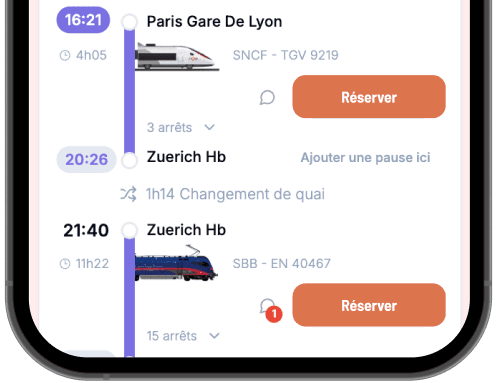
Fictitious illustration of a multi-operator journey with a guaranteed connection on a single European ticket.
For many travelers, the main obstacle to international rail travel is not necessarily the journey time itself, but the uncertainty associated with connections. Knowing that a journey is protected from end to end could therefore profoundly change the perception of long-distance rail travel in Europe.
It should be noted, however, that these protections would only apply to connections that respect the minimum times defined at European level, in order to guarantee journeys that are deemed realistic and feasible.
Unlike air travel, the European rail network is still largely based on connections between several operators and several national networks.
Rail hubs such as Milan, Zurich, Frankfurt and Barcelona already play a key role in long-distance international travel. However, these connections are often difficult for passengers to book in good conditions.
The reform proposed by the European Commission is aimed precisely at better adapt reservation tools and passenger rights to the reality of European railways.
This reform is also part of a broader European Union modal shift strategy. For several years now, Brussels has been seeking to strengthen the role of rail in European mobility, particularly on routes where air travel is still ultra-dominant.
However, the main problem with international rail travel is not always the journey time itself. In many cases, it's the complexity of the purchasing process that discourages travellers.
Simplifying booking, making journeys visible and securing connections could therefore play an important role in rail's ability to compete more effectively with air on certain European routes.
Perhaps the main challenge for European railways is no longer simply to build new lines, but to make the existing system truly legible, interconnected and reliable for travelers.
Today, each operator still has its own reservation systems, its own commercial rules and its own distribution tools. This historical fragmentation sometimes gives the impression that the European rail network functions more as a juxtaposition of national networks than as a true continental network.
With this reform, the European Commission seems to be pushing for a more integrated approach to European railways, in an attempt to bring the various national systems closer together.
At this stage, it is still only a proposal from the European Commission. The text must now be be examined by the European Parliament and the Member States then be the subject of negotiation s before final adoption.
As is often the case in European legislative processes, the final version could evolve significantly as discussions progress. Some measures could be strengthened, while others could be limited or amended.
Practical implementation of the reform is not expected for several years..
Negotiations could prove particularly sensitive on issues relating to ticket distribution and the opening up of reservation systems.
This reform directly affects strategic issues for the rail sector: access to data, customer relations, commercial conditions and the role of independent platforms.
In particular, the text targets operators considered dominant on their national market, i.e. those representing at least 50% of passenger rail services in a Member State.
For their part, some organizations representing incumbent operators have already expressed reservations about the text presented by the European Commission. In particular, they believe that priorities should focus more on rail infrastructure, while several players in the sector are highlighting the technical and commercial complexity of the rail distribution market.
On the other hand, a number of NGOs and travel associations also feel that the reform is still too far-reaching. still insufficient on certain points. In a reaction published after the European Commission's announcement The Climate Action Network welcomes the extension of passengers' rights in the event of a missed connection, but criticizes the scope of the ticket distribution obligation.
According to the association, dominant platforms such as SNCF Connect would only be obliged to sell the tickets of competing operators on journeys originating or terminating in their reference country. In concrete terms, SNCF Connect could thus be obliged to sell a Paris-Milan operated by Trenitalia, but not necessarily a Paris-Rome via Milan combining several Italian operators.
For the Climate Action Network, this limitation risks leaving invisible a large number of rail alternatives to air travel requiring a connection, such as Paris-Madrid, Paris-Rome or Paris-Venice.
The European rail market remains highly fragmented. Each operator has its own tools, its own commercial rules and its own reservation systems.
Making the whole system truly interoperable on a European scale is therefore a major challenge. a particularly complex project We're committed to providing you with the best possible technical, commercial and regulatory solutions.
Several players in the sector also insist on the need to define realistic connection times to avoid creating routes that are theoretically bookable but unreliable in practice. The text provides for liability mechanisms to deal with such situations.
Even if the text is adopted, the transformation of the European train will probably not be immediate.
Implementation should be progressive and will largely depend on the ability of operators, platforms and member states to apply concretely these new rules.
One thing seems increasingly clear, however: the European train is becoming a major political issue in Brussels. And this reform could mark an important step in the transformation of a patchwork of national networks into a truly European railway area. To be continued...
Issue du monde de la communication et des médias, Sophie est Responsable éditoriale chez HOURRAIL ! depuis août 2024. Elle est notamment derrière le contenu éditorial du site ainsi que La Locomissive (de l'inspiration voyage bas carbone et des bons plans, un jeudi sur deux, gratuitement dans ta boîte mail !).
Convaincue que les changements d’habitude passent par la transformation de nos imaginaires, elle s’attache à montrer qu’il est possible de voyager autrement, de manière plus consciente, plus lente et plus joyeuse. Son objectif : rendre le slow travel accessible à toutes et tous, à travers des astuces, des décryptages et surtout, de nouveaux récits.

