
TGV M: SNCF Finally Sets Launch Date for November 6
by
Published on 10/15/26

Inspiration and great deals for your next low-carbon trips



Want to take the train from Paris to Madrid? On paper, the choice seems obvious: a more eco-friendly, more comfortable trip, without the hassles of flying. But when it comes time to book, things get complicated… When searching on SNCF Connect, no options appear. The same goes for Rome, Naples, or Venice: these routes simply seem not to exist.
And yet, they do exist. Every day, with just one transfer, reasonable travel times, and clearly identified operators. This disconnect between the actual service offerings and what travelers perceive is precisely what the new report from Climate Action Network, “Traveling by Train to Europe: A Headache for Passengers,” highlights. Through a detailed analysis of the main European routes, it shows that the problem with rail travel in Europe isn’t just about infrastructure, but a set of structural barriers that make these trips complex, confusing, and sometimes risky. We’ll explain it all.
International rail travel is a reality, and travelers are ready to take advantage of it. However, three structural barriers prevent it from competing with air travel, according to the Climate Action Network report “Traveling by Train to Europe: A Headache for Passengers,” published in 2026:
The report’s first finding concerns the very structure of international rail service. Unlike air travel, which offers numerous direct connections between major European cities, rail travel still relies heavily on transfers.
“Of the 31 air routes that carried more than one million passengers in 2024, 4 cannot be completed by train in a single day, 18 require at least one connection, and only 9 have a direct train,” the report states.
In practice, this means that routes such as Paris–Rome, Paris–Madrid, or Paris–Prague require a stop in another city. While these connections are often straightforward from an operational standpoint (in Milan, Barcelona, or Mannheim, for example), they make the journey less direct for passengers.

© Réseau Action Climat
In the absence of direct connections, the European rail network largely operates through hubs. Certain cities serve as transportation hubs, providing access to numerous destinations with just one transfer. From Barcelona, you can reach Madrid or Valencia; Milan and Turin offer access to Rome, Florence, or Naples; while Frankfurt and Zurich facilitate travel to Central Europe.
This system covers a large part of the continent, but it requires travelers to plan their own itineraries, which can be a barrier to widespread train use.
Even when direct trains are available, their capacity remains very limited compared to air travel. “On the Paris–Barcelona route, airlines offer eight times as many seats as the SNCF,” notes the Climate Action Network.
This imbalance contributes to making trains less visible and sometimes harder to access, particularly on heavily traveled routes such as Paris–Madrid or Paris–Rome.
The report also highlights the gradual disappearance of night trains, which were, in fact, a suitable option for long-distance travel:
“This lack of connections […] can be attributed in particular to the virtual disappearance of international night trains.”
Routes such as Paris–Venice, Hendaye–Lisbon, and Paris–Vienna have been discontinued in recent years, limiting the options for efficient long-distance travel.
Despite these limitations, rail continues to attract passengers when offered under the right conditions. "The Paris–Berlin TGV […] runs at 90% capacity despite a journey time of 8h20", the report notes.
These figures show that travellers are prepared to choose the train, even on long journeys.
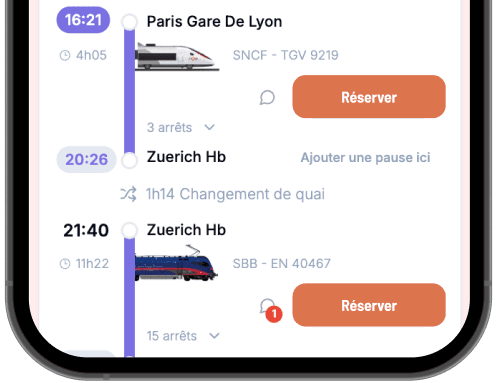
In France, train ticket booking goes primarily through SNCF Connect. Yet this platform does not provide access to the full range of available journeys: "of the 18 routes with a connection that together account for more than one million air passengers, 11 are never visible on the app", the Réseau Action Climat specifies.

© Réseau Action Climat
This affects major routes such as Paris–Rome, Paris–Venice and Paris–Madrid, which are nonetheless achievable by train within reasonable timeframes.
This situation is not solely the result of an isolated choice by the platform, but is also part of a complex European context in which each rail operator has its own reservation and distribution systems, which are often poorly interoperable.
Some platforms do, however, manage to integrate a larger share of these offers. According to the Réseau Action Climat report, Trainline for example is able to display the majority of the routes studied, whereas SNCF Connect remains more limited for journeys involving multiple operators.
This invisibility is largely explained by the fact that SNCF Connect does not sell tickets for many European operators, such as "Trenitalia, Renfe, SNCB, European Sleeper, Italo, Westbahn…"
"Today, when a journey involves several rail companies, it is very often invisible on SNCF Connect because the platform does not distribute many European rail companies. For example, it does not distribute any of the companies that allow travel within Spain (Renfe, Iryo, Ouigo España) or Italy (Trenitalia, Italo). In Germany, it distributes Deutsche Bahn, but not certain other companies, such as European Sleeper, Flixtrain or Westbahn." — Alexis Chailloux, Head of Aviation and Rail at Réseau Action Climat and author of the report
Additionally, the SNCF group has pointed to technical constraints related to a tool change in 2024 that cut certain connections. But these issues do not appear to have been treated as a priority — to such an extent that some international lines, such as the Paris–Vienna and Paris–Berlin night trains, had time to disappear in the interim.
The report highlights a particularly telling example: "the route with a connection in Barcelona is not displayed […] even though SNCF operates the journey end-to-end".
This case illustrates the limits of the current system: a solution exists, it is operated by the same group, yet it remains inaccessible to the traveller.

© Réseau Action Climat
According to the Réseau Action Climat report, SNCF explains this situation by a technical tool change in May 2024, which still temporarily prevents the sale of certain tickets from foreign companies.
The report also mentions limitations related to current distribution systems, as well as price discrepancies between platforms: "The same train […] may be offered from €79 on SNCF Connect, compared to €40 on Trainline or the DB website."

© Réseau Action Climat
These differences make comparison difficult and can give a partial picture of the real cost of rail. They also reflect the coexistence of pricing policies specific to each operator, with different exchange and refund conditions that are not always comparable across platforms.
More broadly, these limitations illustrate the difficulties of a European rail system that remains highly fragmented, where coordination between stakeholders remains a major challenge.
"Today, it is a genuine headache for passengers who want to travel across Europe, particularly when there is a connection. You almost need a PhD in rail to find the right route at the right price." — Alexis Chailloux, Head of Aviation and Rail at Réseau Action Climat

© Réseau Action Climat
One of the main barriers to rail travel in Europe concerns the reliability of connections. "In the vast majority of cases studied (13/18), the connection is not always guaranteed if the first train is delayed", the Réseau Action Climat notes.
This means that travellers do not always have an alternative solution if there is a problem with their first train.

© Réseau Action Climat
If a connection is missed, costs can quickly mount. This risk is clearly a significant deterrent, particularly for long-distance journeys.
The report also highlights the specific difficulties associated with journeys to the United Kingdom. Destinations such as Manchester or Edinburgh are accessible by train via London, but remain difficult to book in a single transaction — which limits their attractiveness compared to flying.
The report highlights alternative solutions that are often more economical but little-known: "It is possible to find tickets from €29 for a couchette between Paris and Latour-de-Carol/Cerbère (though depending on demand this minimum price can rise significantly), followed by a ticket of around €15 for the Catalan regional train."
These journeys rely in particular on combinations of night trains and regional trains, such as between Paris and Barcelona via Cerbère or Latour-de-Carol.
But these solutions are not promoted: "These itineraries are displayed neither on SNCF Connect nor on Trainline", the Réseau Action Climat notes.
These alternatives therefore remain difficult to access for the general public, due to their lack of integration in booking tools.
This report comes at a pivotal moment: the European Commission is preparing an overhaul of the regulatory framework for rail travel. Among the options being considered:
A real window of opportunity, but one whose ambition remains, for now, uncertain.
In April 2026, as part of a framework transport bill, the French Senate voted two concrete measures. The first requires SNCF Connect to sell tickets for competing rail companies that request it, provided they operate on the same routes as SNCF in France. Specifically, this applies to Trenitalia on the Paris-Lyon-Marseille and Paris-Turin-Milan routes, and to Renfe on the Lyon-Barcelona route. The second measure guarantees that passengers will reach their destination if they miss a connection due to a delay or cancellation of the first train, including when that first train is operated by Trenitalia or Transdev, which now operates certain TER trains for the Région Sud.
The measure was not unanimously supported: some lawmakers from the center-right bloc have expressed reservations about the economic risks for the incumbent operator, while the government has shown support for opening up the market. The effective date has been pushed back to late 2027 or 2028, depending on the final wording adopted. The text must still be definitively approved by the Senate, debated in the National Assembly, and then passed in identical terms by both chambers.
These national advances, however, remain limited to French territory. Yet the most intractable problems arise precisely across borders. That is where the problem lies, according to Alexis Chailloux: “Both are good news, but only for France; we, however, are calling for European regulations to go much further.”
What Climate Action Network is advocating for in Brussels goes much further: requiring dominant platforms to also list operators from neighboring countries (at a minimum, those that allow for major air connections, such as Italo or Trenitalia in Italy to reach Naples, Rome, or Venice from Turin or Milan). And guaranteeing full rights to European passengers making connections: arriving at their destination without additional cost, being provided with accommodation in the event of an overnight stay, and receiving financial compensation for the inconvenience.
Problem: There is a high risk that the European Commission will limit its focus to the national level. Specifically, the text could restrict the obligation on SNCF Connect (and its equivalents in other countries) to display only direct connections from the reference country. However, the Climate Action Network report has shown that direct connections are actually the exception on major European routes. Furthermore, it is essential that transferring passengers be guaranteed they can reach their destination without any additional cost (neither having to buy a new ticket at full price, nor paying for accommodation out of pocket if the next train does not arrive or depart until the following day). This is the only acceptable level of ambition for the European train to finally become a credible alternative to air travel.
The Réseau Action Climat report does not merely set out findings: it also puts forward concrete recommendations to address the barriers identified.
The first concerns ticket distribution. The organisation proposes requiring major platforms, including SNCF Connect, to integrate the rail operators that are essential to major European routes — in particular those that make it possible to replicate the main journeys currently served by air, such as Italo in Italy or Westbahn in Germany and Austria.
The objective is straightforward: to allow travellers to access genuinely useful itineraries without having to search multiple platforms.
"The aim is not to integrate 100% of European rail companies, but those that allow the major air routes to be reproduced by train. For example, from France, it is essential to be able to buy Trenitalia or Italo on SNCF Connect in order to reach Rome by train, whereas finding tickets for LTG, the Lithuanian national rail company, is not a priority!" - Alexis Chailloux
The second recommendation concerns passenger rights. The report recommends extending guarantees in the event of a missed connection, so that travellers can continue their journey at no additional cost if their train is delayed, and benefit from accommodation coverage if necessary. A development that would bring rail in line with the standards already in place in aviation.
What the Réseau Action Climat report shows is that the obstacles to rail travel in Europe are not solely a matter of missing lines or trains. The routes exist, the networks are in place and travellers are ready to use them. The issue is that their accessibility remains limited by a set of factors that relate more to the organisation of the system than to its technical capabilities.
The challenge is therefore no longer simply to develop rail, but to make it genuinely accessible. Making rail more attractive at a European scale means better connecting offers, making routes visible and securing connections. These are all levers that could, in time, allow rail to play its full role as an alternative to flying.
Issue du monde de la communication et des médias, Sophie est Responsable éditoriale chez HOURRAIL ! depuis août 2024. Elle est notamment derrière le contenu éditorial du site ainsi que La Locomissive (de l'inspiration voyage bas carbone et des bons plans, un jeudi sur deux, gratuitement dans ta boîte mail !).
Convaincue que les changements d’habitude passent par la transformation de nos imaginaires, elle s’attache à montrer qu’il est possible de voyager autrement, de manière plus consciente, plus lente et plus joyeuse. Son objectif : rendre le slow travel accessible à toutes et tous, à travers des astuces, des décryptages et surtout, de nouveaux récits.

