

International Night Trains: Why Is It Still So Complicated?
by
Published on 11/19/26


Want to get some fresh air in the Austrian Alps without having to rent a car? Head for Tyrol and Vorarlberg, in western Austria! From Paris, one day of train travel and a connection in Zurich are enough to reach Innsbruck or Bregenz. Once there, settle in Innsbruck, Hall-Wattens, the Alpbachtal or the Bregenzerwald, then set off to explore the surroundings by regional train and bus. A bit like our star-shaped trip in Switzerland, but this time in the Austrian valleys!
Can you head to the mountains in Austria without a car? Yes: Tyrol and Vorarlberg can be reached in one day of train travel from Paris, via Zurich. We explain why Munich is rarely the right option in the section “Reaching Tyrol and Vorarlberg by train”.
Where to drop your bags? Innsbruck for the city and the peaks, Hall-Wattens for the peace and quiet nearby, the Alpbachtal for the villages, the Bregenzerwald for its architecture and local crafts. Find the details of the excursions in the section “Which base camp to choose”.
How much does the bus cost on site? Often nothing: the guest card provided by your accommodation includes local buses. But conditions vary from region to region (number of nights, season): see the guest card table.
How long should you stay? Four nights for three days of excursions, a week to combine two base camps. Find our tips in the section “How long to stay?” and our sample itinerary in the section “Summer or winter”.
Can you ski there without a car? Yes, around Innsbruck and in the Alpbachtal thanks to the ski buses included in the guest card. The Bregenzerwald works differently in winter (see the section “Can you ski starting from the station?”).
From Paris, you only need a single connection in Zurich to reach Bregenz or Innsbruck within the day. Leaving in the morning, you can arrive in Vorarlberg by early afternoon, or in Tyrol by the end of the day.
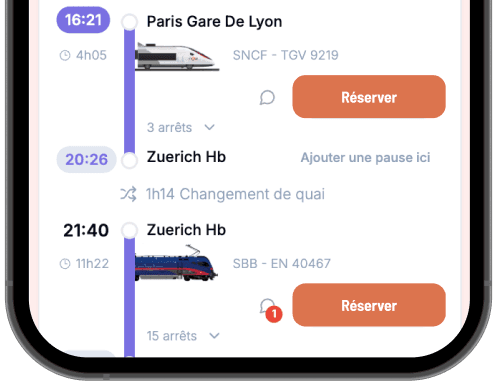
From Paris Gare de Lyon, the TGV Lyria takes you directly to Zurich (4h04 on the fastest trains, according to SNCF Connect), before continuing on to Austria. According to the 2026 timetables published by SBB CFF FFS, the EuroCity Zurich-Bregenz takes about 1h30 and the direct Railjet Zurich-Innsbruck about 3h35.
| Destination | Station to reach from Zurich | Last leg to your accommodation |
|---|---|---|
| Bregenzerwald | Bregenz (EuroCity, about 1h30) | Regional bus to the villages of the Bregenzerwald, or regional train to Dornbirn then bus |
| Innsbruck | Innsbruck Hbf (direct Railjet or EuroCity, about 3h35) | Urban transport depending on your accommodation |
| Hall-Wattens | Innsbruck Hbf (direct Railjet or EuroCity, about 3h35) | Regional train to Hall in Tirol (about 10 min) or Fritzens-Wattens (about 17 min), or bus from Innsbruck station |
| Alpbachtal | Wörgl (same direct train, about 30 min after Innsbruck) | Bus to your accommodation, free of charge on presentation of your booking, or regional train to Brixlegg then bus |
On arrival in Bregenz or Innsbruck, you can continue by regional train or bus (we explain it all a bit further down). Still, be sure to check the timetables on SNCF Connect or the ÖBB journey planner before you leave: works may lengthen the trip.
In 2027, the closure of the “Deutsches Eck” line, between Salzburg and Kufstein, from February 8 to July 9, also changes the timetables of the Zurich-Vienna Railjets.

Sunrise over the Kanisfluh - © Bregenzerwald Tourismus, Benjamin Schlachter
For all four destinations, including the Alpbachtal, the simplest option remains to go via Zurich. For the Alpbachtal, the Alpbachtal tourist office also recommends Wörgl station: from there, the bus to your accommodation is free upon presentation of your booking, and a regional train drops you off in Brixlegg.
Direct Railjet trains departing from Zurich serve Wörgl. However, it's best not to count on Jenbach from Switzerland: starting December 13, 2026, the Railjet Xpress Vienna – Innsbruck – Bregenz line will only stop there at the beginning and end of the day, during works scheduled to last until the end of 2028. Trains coming from Munich, on the other hand, will continue to stop there.
You can also go via Munich to reach the Alpbachtal, especially if you'd like to stop there. The only drawback: there is just one direct TGV Paris-Munich per day: it leaves Paris Est at 3:55 p.m. and arrives at 9:46 p.m., which doesn't allow you to continue to Tyrol the same day. And the additional direct services announced by DB and SNCF depended on the new Stuttgart 21 station, whose commissioning is now postponed to the end of 2031.
The principle is the same as from Paris: head to Zurich, then take the Railjet to Innsbruck or the EuroCity to Bregenz. Both depart roughly every two hours (according to the SBB 2026 timetable). What changes is the route to Zurich.
| Departure | Route to Zurich | Fastest journey to Zurich |
|---|---|---|
| Lyon | Direct TER to Geneva (about 2h), then SBB train; or via Basel | 4h45, first departure at 6:38 a.m. |
| Marseille | TGV to Mulhouse, then TER to Basel and SBB train | 6h45, first departure at 6:33 a.m. |
| Strasbourg | Train to Basel, then SBB train | About 2h50 on average, around thirty journeys per day |
From Lyon, the simplest option is the direct TER Lyon Part-Dieu–Geneva, which takes under two hours on the fastest trains, then an SBB train to Zurich. Leaving in the morning, both Tyrol and Vorarlberg can be reached the same day.
From Marseille, it's a long day: count at least 6h45 to Zurich, with the last useful departure at 3:55 p.m. according to SNCF Connect. Leave on the first train if you're aiming for Innsbruck that same evening, or stop over in Basel or Zurich. In summer, a seasonal TGV Lyria also links Marseille to Geneva.
From Strasbourg, Zurich is only a few hours away via Basel, making it the simplest French departure point for western Austria. For the Alpbachtal, an alternative exists via Munich: seven Railjet trains per day link Munich to Jenbach in about 1h30.
These journey times apply to the 2026 timetable: check them on SNCF Connect for your departure date (especially since the timetable changes on December 13, 2026).

Family-friendly path along the Reintalersee in Kramsach in summer - © Alpbachtal Tourismus, Mathäus Gartner
No need for a car to explore the area: between regional trains and bus networks, there are plenty of options. And thanks to the guest card provided by your accommodation, a good part of your journeys is included in your stay. Just check the eligibility conditions: they depend in particular on the length of your stay, the season and the accommodation you choose.
In Tyrol, the Inn Valley is served by regional trains and the ÖBB S-Bahn: from Innsbruck, they stop at Hall in Tirol, Fritzens-Wattens, Jenbach, Brixlegg and Rattenberg-Kramsach, among others (ÖBB timetable, line 300). From Brixlegg station, the regional buses of the Alpbachtal leave right in front of the station for the villages in the valley.
In the Bregenzerwald, there is no railway station: to get around this part of Vorarlberg, you need to take the bus. The Landbus Bregenzerwald network links the villages to each other and connects them to the stations of Bregenz and Dornbirn, with for example line 840 Bregenz-Egg-Bezau-Schoppernau or line 850 Dornbirn-Egg-Bezau (more info at Bregenzerwald Tourismus). In summer, some buses equipped with a trailer can even take your bike: in 2026, line 8R1 (Thursday to Sunday) and line 8R2 (Sunday) ran from May 14 to October 4, at €8.50 per day per bike.
Where to check the timetables? To plan your trips, the VVT journey planner lets you search for train and bus connections across Austria, with real-time traffic information. Handy for organizing your car-free excursions!
In each of these regions, your accommodation can give you a free guest card: it can't be bought separately. It lets you use local transport without paying extra, except in the Bregenzerwald where this benefit is reserved for summer. However, keep in mind that the conditions are not the same everywhere.
| Card | Where | From how many nights | Transport included | Chairlifts |
|---|---|---|---|---|
| Welcome Card / Welcome Card plus | Innsbruck region | 2 nights (plus: 3 nights), at a partner host | Public transport in the Innsbruck region, including the city, and ski bus in winter | Discounts, and a few free trips with the plus version |
| Hall-Wattens Card | Hall-Wattens region | Provided by the accommodation | All buses in the region, and the bus from Innsbruck Hbf to your accommodation on arrival | Discounts on leisure activities |
| Alpbachtal Card | Alpbachtal | From the 1st night | Regional buses in the valley, ski bus in winter | Summer lifts included |
| Gäste-Card Bregenzerwald & Großes Walsertal | 27 partner municipalities in 2026 | 3 nights, from May 1 to October 31 only | Summer lifts included, outdoor pools too | Summer lifts included |
Good to know in the Alpbachtal: the bus from Wörgl or Brixlegg stations to your accommodation is free upon presentation of your booking confirmation (Alpbachtal Tourismus). Same logic in Hall-Wattens with the card, which you can receive by email before your departure.
Can you get your guest card before arrival? In some regions, yes! In Innsbruck and Hall-Wattens, you can ask your accommodation to send it to you in advance, so you can enjoy the included transport from the moment you arrive. In the Alpbachtal, the card is activated on arrival, but your booking confirmation is enough to take the regional buses free of charge from certain stations, notably Wörgl and Brixlegg. Be sure to check with your accommodation before you leave.

View of the Inntal and the Voldertal - © Tourismusverband Hall-Wattens
Before booking, check the guest card conditions: 3 nights minimum in the Bregenzerwald to get the Gäste-Card in summer, 2 nights in Innsbruck for the Welcome Card and 3 for the plus version. With four nights on site, you have three full days to explore. And if you're staying for a week, you can even combine two bases.
If you're changing accommodation and would rather travel without your suitcases, ÖBB offers a door-to-door luggage service in Austria, South Tyrol and Germany, bookable only with a valid ÖBB ticket, no later than three business days before pickup. If you just want to make a stop between two trains, lockers are available at many stations, including Bregenz and Dornbirn.
Want city and mountain in the same day? Head to Innsbruck. Prefer to sleep somewhere quiet while staying close to the city? Head to Hall-Wattens. If you're more into villages and lakes, check out the Alpbachtal. And if you're drawn to architecture and local crafts, the Bregenzerwald is well worth the detour. Can't make up your mind? Good news: the first three destinations are all on the same railway line, making them easy to combine! The Bregenzerwald, for its part, lies further west, on the shores of Lake Constance.
In Innsbruck, a few minutes are enough to leave the old town behind and gain altitude without even boarding a bus. The Nordkettenbahnen depart from the Congress station, five minutes from the Golden Roof, and three lifts take you up in under 30 minutes to the Hafelekar station, at 2256 meters (more info here). Once up there, the Karwendel nature park is just a stone's throw away.

Left: The Avent in Innsbruck © Österreich Werbung, Roman Huber, Fabian Künzel / Right: Maria-Theresien-Strasse in Innsbruck © Österreich Werbung, Sarah Dawalibi, Le Blog de Sarah
For day trips, the Welcome Card covers public transport in the Innsbruck region. Hall in Tirol is about ten minutes away by train, and the Alpbachtal between 30 and 50 minutes depending on the station you're headed for (Jenbach, Brixlegg or Wörgl).
Want to visit Innsbruck but sleep somewhere more peaceful? Hall-Wattens is a good alternative. Hall in Tirol is home to the largest old town in western Austria, according to the region's tourist office.

View of the town of Hall in Tirol - © www.hall-wattens.at
In Hasegg Castle, the Münze Hall museum traces the history of thaler minting, those old coins that notably gave the dollar its name. And from the Münzerturm tower, you can enjoy a lovely view over the town.

Hall in Tirol - © Tourismusverband Region Hall-Wattens
In Wattens, the Swarovski Kristallwelten (Crystal Worlds) have been fascinating visitors since 1995: more than 18 million have already been through. Austrian artist André Heller conceived the place for Swarovski's 100th anniversary, drawing inspiration from the cabinets of curiosities at Ambras Castle in Innsbruck. Inside, the Chambers of Wonder (Wunderkammern) bring together works by Salvador Dalí and Andy Warhol, along with crystal installations created on site by artists such as Yayoi Kusama and Brian Eno.

Yayoi Kusama's Chamber of Wonder at the Swarovski Kristallwelten - © Swarovski Kristallwelten
Outside, the park spans 7.5 hectares. You can't miss the Giant, the site's emblem: a grass-crowned head from which a waterfall gushes, guarding the entrance to the Chambers of Wonder. Architectural Digest even ranked it among the most beautiful fountains in the world. Further on, the Kristallwolke, a cloud of more than 800,000 crystals hand-placed by the duo Cao Perrot, floats above a pool of black water where its sparkles are reflected. The more playful visitors will also lose themselves in a hand-shaped plant maze, signed by André Heller.

The Giant at Swarovski Kristallwelten - © Swarovski Kristallwelten
For hiking, the Karwendel nature park, the largest in Tyrol, starts just above the valley. With the Hall-Wattens Card, regional buses are free, including the one that takes you from Innsbruck station.

Hiking in the Hall-Wattens region - © Tourismusverband Region Hall-Wattens
Between the Inn valley and the mountains, the Alpbachtal brings together ten municipalities, including several typically Tyrolean villages.

Center of Alpbach village and its traditional wooden architecture - © Alpbachtal Tourismus, Alberto Campanile
Alpbach and its wooden chalets, Rattenberg (the smallest municipality in Austria by area, at 0.11 km²), the lakes of Kramsach and the Museum Tiroler Bauernhöfe, the largest open-air museum in Tyrol (more info at Alpbachtal Tourismus).

Sunrise with rosy glow over the Reintalersee in Kramsach - © Alpbachtal Tourismus, TwoSomePioneers, Maja Eifert
To discover these places without a car, the tourist office offers the "KulTour" circuit, to travel by hopping on and off the bus as you please: a loop of about 35 km by regular bus, from Alpbach to Kramsach and back, via Brixlegg and Rattenberg. Good to know: regional buses and summer lifts are included in the Alpbachtal Card.

Downtown Rattenberg - © Alpbachtal Tourismus
If you love architecture and woodworking, the Bregenzerwald should appeal to you. At the Werkraum Haus in Andelsbuch, a building designed by Swiss architect Peter Zumthor, winner of the prestigious Pritzker Prize, the Werkraum Bregenzerwald showcases the craftsmanship of the region's artisan businesses. Twelve "Umgang Bregenzerwald" walks reveal the architecture of twelve villages.

Design bus shelter in Krumbach in the Bregenzerwald - © Österreich Werbung, Lisa Eiersebner - Architecture Sou Fujimoto
In Krumbach, seven bus shelters were designed by seven international architecture firms and built with local artisans; only fitting, since you get there by bus, on line 820 from Bregenz.

BUS STOP bus shelter in Krumbach in the Bregenzerwald © Off The Path, Sebastian Canavec - Architecture Wang Shu, Lu Wenyu
You can also spend a day in Bregenz and on Lake Constance, both reachable by bus from the valley.
From May to October, traveling car-free is especially easy: guest cards offer the most perks then, including access to the lifts. But a winter stay is perfectly possible too, by choosing a resort served by ski buses.

Freeriding in Warth-Schröcken in the Bregenzerwald © Bregenzerwald Tourismus, Maximilian Gierl
To set off on a walk, you often just need to hop off the bus or take a lift. In Innsbruck, the Nordkettenbahnen drop you on the ridge of the Nordkette, with trails facing the city and the Karwendel.
In the Alpbachtal, the guest card also includes guided hikes: in 2026, the walk around the Kramsach lakes (Mondays, from June to early November) and the outing to the Tiefenbachklamm gorge were free with the Alpbachtal Card (program available here).

Autumn hike on the Sagtaler, Top of Alpbachtal, in Alpbach - © Alpbachtal Tourismus, Shootandstyle.com
In the Bregenzerwald, the "culinary hikes" formula combines a marked trail with vouchers for breakfast, lunch and dessert at inns along the way. Bregenzerwald Tourismus offers seven of them in 2026, bookable by the day.
Yes! You just need to choose an accommodation from which you can reach the slopes by ski bus. Around Innsbruck, the Welcome Card includes ski buses to the resorts covered by the SKI plus CITY Pass Stubai Innsbruck. In the Alpbachtal, the ski bus is free with the Alpbachtal Card and takes you from Alpbach to the valley resort in about 5 minutes. The Ski Juwel Alpbachtal Wildschönau has 114 km of slopes and 45 lifts (with a 2026-2027 season running until April 4, 2027).

Picturesque village under the snow in the Alpbachtal - © Österreich Werbung, Stefan Strasser
In the Bregenzerwald, the Gäste-Card doesn't work in winter: it's holders of the 3Täler pass who can take public buses or ski buses to the resort of their choice. ÖBB also offers passes combining train and ski, like "Im Nightjet zum Schnee" for the Ski Juwel. Note, though: these trains depart from Germany or the Netherlands.

Wildmoos with a view of the Hangspitze © Bregenzerwald Tourismus, Michael Meusburger
If rain or snow crashes the program, there's plenty to keep you busy indoors. In Wattens, the Swarovski Kristallwelten and their "chambers of wonders"; in Hall, the Münze Hall museum in Hasegg Castle. In the Alpbachtal, the Brixlegg mine museum, on the KulTour route, is open from June to September. In the Bregenzerwald, the Werkraum Haus in Andelsbuch hosts temporary exhibitions (for example the "Lösungen für den Alltag" (Solutions for Everyday Life) show, from November 14, 2026 to October 19, 2027).
Days 1 to 3: Bregenzerwald. Arrive in Bregenz via Zurich, bus to your accommodation. One day of architecture (Werkraum Haus, Krumbach bus shelters), one day of culinary hiking. Three nights, exactly what the Gäste-Card requires.
Day 4: Change of base camp. Railjet from Bregenz to Innsbruck, direct every two hours according to ÖBB. To travel light, hand your bags over to ÖBB's door-to-door service, to be booked at least three business days in advance.
Days 5 to 7: Innsbruck or Hall-Wattens. Nordkette, Hall's old town, the Crystal Worlds, and a day in the Alpbachtal by regional train to Brixlegg.
Day 8: Return via Zurich.
Once you've picked your train journey and base camp, all that's left is to enjoy the Austrian Alps! Innsbruck and Hall-Wattens to mix city and peaks, the Alpbachtal for the villages, the Bregenzerwald for design: it's up to you to compose. Just check the terms of each card before booking, and time your dates to the season that tempts you. So, when are you leaving
Article produced in partnership with Austria Tourism.
*Cover image credits, from left to right:
- The Avent in Innsbruck © Österreich Werbung, Roman Huber, Fabian Künzel
- The Giant at Swarovski Kristallwelten
- © Swarovski Kristallwelten
- Sunrise with rosy glow over the Reintalersee in Kramsach
- © Alpbachtal Tourismus, TwoSomePioneers, Maja Eifert
- Freeride at Warth-Schröcken in the Bregenzerwald © Bregenzerwald Tourismus, Maximilian Gierl
Issue du monde de la communication et des médias, Sophie est Responsable éditoriale chez HOURRAIL ! depuis août 2024. Elle est notamment derrière le contenu éditorial du site ainsi que La Locomissive (de l'inspiration voyage bas carbone et des bons plans, un jeudi sur deux, gratuitement dans ta boîte mail !).
Convaincue que les changements d’habitude passent par la transformation de nos imaginaires, elle s’attache à montrer qu’il est possible de voyager autrement, de manière plus consciente, plus lente et plus joyeuse. Son objectif : rendre le slow travel accessible à toutes et tous, à travers des astuces, des décryptages et surtout, de nouveaux récits.


