

How do we process your data?
We use cookies to improve your browsing experience and personalize our content. They are mainly used for statistical purposes.
Inspiration and great deals for your next low-carbon trips



Is it really possible to travel to Scandinavia by train from France? Yes, it is possible to travel to Norway by train, to Sweden by train, and even to Denmark by train from France—without flying.
And it's actually getting easier and easier! With:
- the launch of the Paris-Hamburg overnight train via European Sleeper beginning July 13, 2026,
- the arrival of a Direct daytime train from Hamburg to Copenhagen to Stockholm operated by Snälltåget,
- improved connections between Germany, Denmark, Sweden, and Norway (particularly with the future time savings made possible by the Fehmarn Belt Tunnel between Germany and Denmark),
- the announced return of the SJ's direct high-speed train from Copenhagen to Stockholm (Fall 2026),
- the announcement of the Return of a direct Berlin-Oslo train starting in 2028,
- the announcement of a future Brussels/Amsterdam–Copenhagen/Malmö night route by European Sleeper and RDC, starting in April 2028, which will further strengthen the rail network to the north,
- the return of the passenger trains between Finland and Sweden Starting August 10, 2026, with two round trips daily between Oulu, Tornio, and Haaparanda,
- but also the arrival of major new European routes such as Prague–Copenhagen in the summer of 2026...
The North is more accessible than ever—even without flying!
Copenhagen in 24 hours, Stockholm or Oslo in 36 to 48 hours, Lapland in two nights (sometimes with a transfer, depending on the season)… Traveling through Scandinavia by train is no longer a pipe dream reserved for rail enthusiasts; it’s now a real travel option. And above all, The journey is an integral part of the adventure : Traveling through Germany at dawn, crossing the Øresund Bridge between Copenhagen and Malmö, heading up into the snow-covered forests of northern Sweden, gradually discovering the fjords, the Nordic capitals, and perhaps even the Northern Lights…
This comprehensive guide to traveling to Scandinavia by train from France explains, step by step, how to get to Norway, Sweden, or Denmark without flying.
Let’s be clear: yes, it takes longer than flying. But it’s doable, and it’s getting easier and easier via Germany (especially Hamburg). To give you an idea, here are some approximate travel times from booking platforms (which, of course, vary depending on the route, connections, and season).
On average, count 48 hours from France including: a late-afternoon departure, an overnight stay on a night train or at a hotel, connections, and possibly a “leisure” stop (exploring Hamburg, Copenhagen, or Malmö along the way).
The main change in 2026 is, above all, the simplification of connections: Stockholm is gradually becoming accessible with far fewer transfers than before!
In other words, in less than two days, you can be in Oslo or Stockholm without rushing, without having to get up at 4 a.m. to head to the airport, and while discovering a few hidden gems along the way!

Stockholm, the capital of Sweden, accessible by train from France
That's the big bonus: traveling through Scandinavia by train is a gradual journey where the journey is an integral part of the adventure. You don’t “teleport” to the North: you watch Europe change through the window as you pass through Germany, Denmark, Sweden, and Norway one after another, with each stop offering its own unique landscapes and atmosphere. And you can even add a few stops along the way to explore the Nordic cities!
A few highlights worth checking out (among others):

Article
Copenhagen: Our Complete Guide to Exploring the Danish Capital by Train
To give you an idea, the TGV in France emits an average of 3.3 gCO₂e per passenger per km, while a medium-haul flight (1,000–3,500 km) emits an average of 187 gCO₂e per passenger per km. Some orders of magnitude:
| Destination | Distance “as the crow flies” | Train (≈ 3.3 g/km) | Airplane (≈ 187 g/km) | Ratio |
|---|---|---|---|---|
| Copenhagen | 1,028 km | ~3.4 kg CO₂e | ~192 kg CO₂e | ~57× |
| Oslo | 1,343 km | ~4.4 kg CO₂e | ~251 kg CO₂e | ~57× |
| Stockholm | 1,545 km | ~5.1 kg CO₂e | ~289 kg CO₂e | ~57× |
It is entirely possible to travel to Scandinavia by train from Paris without flying, in 24 to 48 hours depending on the destination and connections.

Denmark, Sweden, and Norway have never been more accessible by train from France!
If there’s one key city for traveling to Scandinavia by train from France, it’s Hamburg. Located in northern Germany, it is now the the main rail hub for Copenhagen, Malmö, Stockholm, and Oslo, and the natural dividing line between continental Europe and Scandinavia.
In practice, Hamburg also lets you:
Whether you're heading to Denmark, Sweden, or Norway, your route will almost always take you through there! Here's a specific example of a route to Sweden:
Day 1: Paris → Hamburg (+/) with a tour of Hamburg)
Day 2, morning: Hamburg → Copenhagen

Article
What to Do in Copenhagen in 2 Days During? Our Micro-Adventure in the Danish Capital
Day 2, afternoon: Copenhagen → Malmö
And you'll be in Sweden in less than 24 hours—without flying!
In short, Hamburg is

Beautiful Hamburg at Night
Big news for 2026: Starting on July 13, 2026, the European company European Sleeper will connect Paris to Hamburg by night train as part of its Paris-Berlin route.
In practical terms, this means:
This train thus turns Hamburg into a rail gateway to the North—no need for a flight or waking up at dawn for a low-cost flight.
Why is this great news for your plane-free trips to Scandinavia? Because arriving in Hamburg at 7 or 9 a.m. lets you head straight to:
You can do all of this without having to stay overnight at a hotel along the way if you plan your connections well.
If you prefer to travel during the day, Hamburg is also accessible by high-speed train.
Once you arrive in Hamburg, you have three main options: Denmark, Sweden, and Norway. This is where the trip truly becomes a Nordic experience.
The train from France to Copenhagen is the most direct way to travel to Scandinavia without flying.
From Hamburg Hauptbahnhof, direct trains operated by Deutsche Bahn (DB) and the Danish State Railways (DSB) connect Copenhagen in about 4½ to 5 hours (depending on the services and construction in progress), with several trains a day. No complicated transfers: you board in Hamburg and get off in Copenhagen.

The Charm of Copenhagen
In the medium term, the the future Fehmarn Belt Tunnel between Germany and Denmark This should further speed up train travel between Hamburg and Copenhagen, with an estimated time savings of about 1 hour and 30 minutes!

Article
Fehmarnbelt: the giant tunnel under the Baltic Sea that could transform rail travel in Europe
Yes, it's possible to travel to Stockholm by train from France without flying. And best of all, the trips are much easier than they used to be.
Since May 2026, the Swedish rail operator Snälltåget has been offering a Direct daytime train between Hamburg, Copenhagen, and Stockholm, with no transfers. A major improvement for travelers coming from France: it is now possible to reach the Swedish capital via a much more straightforward route, with just one major connection in Hamburg from Paris.

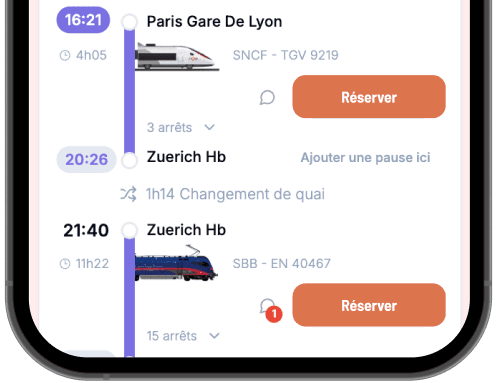
The Paris-Stockholm route, via our HOURRAIL app!
For those who wish to stop over in Denmark, it is, of course, still possible to travel from Copenhagen to Malmö via the Øresundståg trains, which cross the spectacular Øresund Bridge in about 35 minutes.
Starting in the fall of 2026, SJ also plans to relaunch its direct X2000 high-speed train between Copenhagen and Stockholm, without a stop in Malmö. This significant improvement will make rail travel to Sweden even more convenient.

The famous Øresund Bridge, between Sweden and Denmark
From Malmö, SJ long-distance trains travel to Stockholm in about 5:00 a.m. to 5:30 a.m. depending on the type of service (X2000 express or InterCity).
Starting in the fall of 2026, SJ also plans to fast, direct connections between Copenhagen and Stockholm, avoiding a transfer in Malmö.

Malmö and its lighthouse
Stockholm is therefore just one day further away than Hamburg.
Traveling to Oslo by train from Paris is now perfectly feasible by connecting through Hamburg, Copenhagen, and Malmö.
Starting on June 15, 2026, the Swedish company Snälltåget will launch a daily daytime flight: Malmö - Gothenburg - Oslo, for a trip of about 6:30 a.m. to 7:00 a.m..
The Norwegian company Vy It also operates direct daytime flights, mainly on weekends and holidays, between Oslo and Malmö.

Welcome to the Port of Oslo
Once in Oslo, it's impossible not to mention the Bergensbanen, the railway line connecting Oslo and Bergen, operated by Vy, which connects Oslo and Bergen via 6:30 a.m. to 7:00 a.m..
It is one of the most famous train routes in Europe, and it's easy to see why: this line winds through mountainous plateaus, fjords, and spectacular Nordic landscapes.

The historic village of Bergen, a UNESCO World Heritage Site
The Scandinavian rail network remains very reliable overall, but some lines—particularly those heading north in Sweden—are currently undergoing construction and service adjustments.
👉 As a result, some trips may take a little longer or be less direct than before, but they are still entirely feasible.
🚆 Toward a Revival of Major Nordic International Routes
Starting in 2028, a direct train Berlin ↔ Oslo will be relaunched through a partnership between Deutsche Bahn, DSB, and Vy. The line, which has been out of service for more than 20 years, will connect the German and Norwegian capitals in about 14 to 15 hours via Copenhagen and Hamburg.
In practical terms, this means you'll be able to visit the Norwegian capital from Paris with just one transfer in Berlin!
Another clear sign of this trend: European Sleeper and the German operator RDC announced on August 25, 2026, a strategic partnership to launch a Direct overnight service between Brussels/Amsterdam and Copenhagen/Malmö starting in April 2028. This marks a first for European Sleeper on the route to Scandinavia, which would fill what the two partners describe as “the missing link” between the Benelux countries and Northern Europe. On paper, departures are scheduled for around 7 p.m., with arrival the next day around 10 a.m., featuring seats, couchettes, and sleeper compartments (“Deluxe” options are under consideration). Please note, however, that the official capacity request to infrastructure managers is not scheduled until April 2027, so final schedules and fares are still to be confirmed.
What does this say about rail travel in Europe? Despite the challenges and the numerous construction projects still underway on certain lines, something seems to be slowly changing across the continent. The gradual return of night trains, new partnerships among European operators, and the launch of new international routes (such as Prague–Copenhagen, the future Berlin–Oslo line, and the future Brussels–Malmö connection) all suggest that a new vision of European rail travel may be emerging.
However, these advances remain fragile and heavily dependent on public investment, infrastructure, and cooperation among nations.
| Final destination | Main Route from Hamburg | Approximate duration | Reservation |
|---|---|---|---|
| Copenhagen | DB/DSB Direct Train | ~4:30–5:00 | Deutsche BahnDSB |
| Malmö | Hamburg → Copenhagen → Malmö | ~5 hours | Deutsche BahnØresundståg |
| Stockholm | Hamburg → Stockholm (Snälltåget direct) or Hamburg → Copenhagen → Stockholm | ~10:00–11:00 a.m., depending on the route | SJ / Snälltåget |
| Oslo | Hamburg → Copenhagen → Malmö → Oslo | ~10 a.m.–12 p.m. | SnälltågetVy |
| Lapland (Abisko) | Hamburg → Copenhagen → Stockholm → overnight train | ~1 day + 1 night | SJ Night Train |
It’s one of the most beautiful train trips in Europe! Instead of taking a direct flight to Lapland, you can gradually make your way north toward the Arctic Circle by train, all the way to the northernmost reaches of Sweden—or even Norway—and turn your journey into an adventure. Our recommended route: Paris → Germany → Denmark → Sweden → Arctic Circle.
Starting August 10, 2026, VR will connect Oulu, Kemi, Tornio, and Haaparanda with two round-trips daily. This route marks the return of passenger trains between Finland and Sweden after several decades of interruption and reconnects northern Finland to the Swedish rail network.
In practical terms, this does not yet provide a direct route from France to Helsinki or Rovaniemi. But it’s a significant step forward in planning round-trip journeys through the Far North: arriving via Sweden, crossing the border at Haaparanda/Tornio, and then continuing on to Oulu, Helsinki, or Finnish Lapland.
Please note: Connections in Haaparanda with the Swedish Norrtåg trains to Luleå are still set to be improved starting in December 2026. Be sure to check the schedules carefully before planning your itinerary.
The Swedish company SJ (Statens Järnvägar) operates the Stockholm–Abisko–Kiruna–Narvik overnight train. It’s a very comfortable overnight train (with sleeper cars and berths) that departs from Stockholm in the evening and arrives in Lapland the next morning.
⚠️ Coming up in 2026 : The overnight train service to northern Sweden is currently experiencing delays.
👉 The train is still running, but be sure to check your itinerary carefully when you book.
What does this say about rail travel in Europe? These recent changes illustrate a broader reality: despite their return to Europe, night trains still depend on political decisions and public investment.

Article
Arctic Circle Train: the magic of the Stockholm-Narvik night train through Swedish Lapland
Abisko is known for its weather conditions, which are particularly favorable for viewing the Northern Lights. The Swedish Tourist Association (STF) points out that the region often benefits from a “blue hole” in the weather, with clearer skies than in other parts of Lapland.

Article
Abisko: the ultimate guide to organise your trip
In practical terms, this means: less cloud cover, less light pollution, and the ability to observe directly from Abisko National Park.
From Paris:
That is, approximately 2 days + 1 night on the train to reach the Arctic without flying.

The Northern Lights in Abisko: A Magical Spectacle
The SJ night train does not stop at Abisko; it continues on to Narvik, which is located on the shore of a fjord, north of the Arctic Circle. From Narvik, it is possible to travel to Tromsø by regional bus (operated by Troms fylkestrafikk).
⚠️ In 2026, direct access to Narvik by night train will be temporarily disrupted due to construction in northern Sweden.
👉 Some routes require a transfer, which may slightly extend the travel time.
Big news for the Winter 2026 : the Swedish operator Snälltåget will launch a special train service between Malmö and Narvik to allow travelers to reach the Scandinavian Arctic and see the Northern Lights without flying.
This exceptional journey will travel across all of Sweden via Stockholm before crossing the Arctic Circle, with stops in Kiruna, Abisko, or Björkliden—some of the best spots in Europe for viewing the aurora.
Here’s a closer look at a route that’s 100% travelable by train via European Sleeper, Deutsche Bahn, DSB, SJ, Snälltåget, and Vy—one that combines Nordic capitals with Arctic nature and alternates between day and night trains to make the most of your time. A tour that lets you See the Northern Lights without flying by turning the trip into a real adventure in Northern Europe.
You leave Paris in the evening aboard the European Sleeper night train. Settle into your berth or cabin, enjoy a light dinner, and then drift off to sleep to the rhythm of the tracks. When you wake up, northern Germany is already rolling by outside the window.
Breakfast in Hamburg or a direct connection to Denmark. In about 4 hours and 30 minutes, you’ll arrive in Copenhagen, a capital city on a human scale, with its blend of Scandinavian design, canals, and bicycles everywhere.
In the morning, cross the Øresund Bridge into Sweden before continuing on to Stockholm.
Starting in the fall of 2026, SJ also plans to relaunch a direct high-speed train between Copenhagen and Stockholm, without a stop in Malmö.
If you'd rather make the most of your trip from Germany, you can also take the direct Snälltåget train from Hamburg to Stockholm, with no transfers.
Explore Gamla Stan, the museums (Vasa, ABBA), the city ferries, and the Nordic cafés. Stockholm is the perfect place to slow down before heading north toward the Arctic.
Depart in the evening on the SJ Night Train. A sleeper car, a cozy atmosphere, and in the early morning: snow-covered landscapes (depending on the season) and arrival in Swedish Lapland!
⚠️ In 2026, this route may include a transfer (notably at Boden) due to construction work on the line.
On the agenda: hikes, the silence of the Arctic, and in the evening… a hunt for the Northern Lights.
Then head back south on the overnight train. It’s a chance to take one last look at the Arctic landscapes before returning to the Swedish capital.
A comfortable 4.5–5.5-hour trip with SJ, with the option to stop in Gothenburg if you want to break up the trip.
Direct Snälltåget train (starting June 15, 2026) or a connection via Gothenburg. It takes about 6½ to 7 hours to reach Norway and explore Oslo, the capital nestled between fjords and wooded hills.
Back south via Gothenburg and Copenhagen, then Hamburg. A perfect stopover day to make one last stop in Germany before heading to France.
And finally, a night train or a daytime ICE to Paris. The end of a journey that will have taken you through five European countries without a plane!
From the Paris-Hamburg overnight train to the Arctic landscapes of Lapland, it’s now possible to travel to Oslo, Stockholm, Copenhagen, or Abisko without flying.
To wrap up this guide, as you’ve probably realized: traveling to Scandinavia by train isn’t about choosing the fastest option, but rather the most leisurely and rewarding journey, full of discoveries. But as the current situation in northern Sweden shows, these routes remain vulnerable. All the more reason to take them and support their development!
Issue du monde de la communication et des médias, Sophie est Responsable éditoriale chez HOURRAIL ! depuis août 2024. Elle est notamment derrière le contenu éditorial du site ainsi que La Locomissive (de l'inspiration voyage bas carbone et des bons plans, un jeudi sur deux, gratuitement dans ta boîte mail !).
Convaincue que les changements d’habitude passent par la transformation de nos imaginaires, elle s’attache à montrer qu’il est possible de voyager autrement, de manière plus consciente, plus lente et plus joyeuse. Son objectif : rendre le slow travel accessible à toutes et tous, à travers des astuces, des décryptages et surtout, de nouveaux récits.

