


by

How do we process your data?
We use cookies to improve your browsing experience and personalize our content. They are mainly used for statistical purposes.
Inspiration and great deals for your next low-carbon trips


In the Julian Alps, just a few kilometers from Jesenice, Bled is THE postcard image of Slovenia: an emerald-green glacial lake, an island with a Baroque church, and a castle perched on a cliff since the 11th century. It’s a compact destination that’s easy to explore on foot and easily accessible by train.
As with Jesenice, The most direct route goes through Germany and Austria. From Paris-Gare de l'Est, a direct TGV inOui departs every day in the early afternoon for Munich, for a trip lasting about 5 hours and 50 minutes, with an evening arrival that makes it a good idea to spend the night there.
The next day, toward Villach, Austria : The direct trip takes about 4 to 4.5 hours, with no transfers, on a line that also passes through Salzburg. From Villach, there are two options for the final leg to the lake: the Lesce-Bled train station, on the main Villach–Ljubljana line, about 3.7 km from downtown Bled (followed by a bus, taxi, or walk), or an additional transfer at Jesenice to reach the Bled Jezero station, just 1.5 km from the lake but with less frequent service.
Another option: Paris → Zurich by TGV Lyria (about 4 hours), then by train or overnight train to Austria via Innsbruck and Villach, if you'd rather cross the Swiss Alps rather than Germany.
Once you're there, you won't need a car: the Lesce-Bled train station is connected to downtown Bled by regular buses, and the entire area is easy to explore on foot or by bike.
About 4 km on foot from the village—a 50- to 60-minute walk (or about 20 minutes by bike, and a shuttle bus in the summer)— the Vintgar Gorge is also worth a visit: suspension bridges over the turquoise waters of the Radovna River, carved into the limestone rock for 1.6 km.
You can't miss the Pletna boat ride, these flat-bottomed wooden boats steered by a single rower standing upright—a local tradition dating back to the 17th century. The crossing to Bled Island, Slovenia’s only natural island, takes about fifteen minutes and allows visitors to climb the 99 steps to the Church of the Assumption, where ringing the wishing bell is part of the ritual.
On the shore, the Bled Castle overlooks the lake from a cliff 130 meters high. One of the oldest castles in Slovenia, with origins dating back to the year 1004, it is worth visiting for its museum, its Baroque chapel, and above all for the breathtaking view of the lake and the Julian Alps.
For the most iconic view, head to the lookout points at Mala Osojnica and Ojstrica, which are a 30- to 45-minute walk from the village: this is where the photos that made the lake famous were taken, featuring the island, the castle, and the mountains in the background.
About a 20-minute walk or bus ride away in the summer, the Vintgar Gorge Also worth a visit: suspension bridges over the turquoise waters of the Radovna River, carved into the limestone rock for nearly 1.6 km.
Around the lake, a 6-km trail that is fully accessible on foot or by bike It allows you to walk all the way around the lake, with several designated swimming areas in the summer, while the nearby Lake Bohinj—which is wilder and less crowded—is easily accessible, allowing you to continue exploring Triglav National Park.
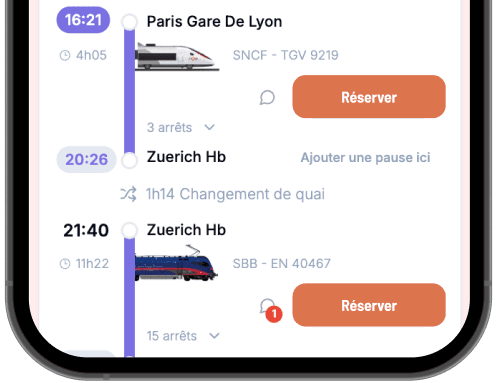
appCreate your train trip step by step and quickly find the best no-flight options.

Enrich this content and showcase how accessible your destination is by train, like our recent partners: , .