How do we process your data?
We use cookies to improve your browsing experience and personalize our content. They are mainly used for statistical purposes.
Inspiration and great deals for your next low-carbon trips


At the foot of the Julian Alps, on the Austrian border, Jesenice surprises visitors with its dual character: a city of iron and steel for over a century, and the gateway to Triglav National Park. Far from the postcard-perfect image of Bled, just a few kilometers away, it offers a rougher, more authentic glimpse of Slovenia.
From Paris-Gare de l'Est, a direct TGV inOui departs for Munich every day in the early afternoon, with a travel time of about 5 hours and 50 minutes. Since it arrives in Munich in the evening, the most comfortable option is to spend the night there before continuing on.
The next day, we’re heading to Villach, Austria, via Salzburg: the trip takes about 4 to 5 hours, with a transfer in Salzburg. Villach is the region’s major rail hub, a key transit point between Germany, Austria, and Slovenia.
From Villach, a final short hop of about 36 minutes takes you directly to Jesenice, on the historic line connecting Munich to Ljubljana, Belgrade, and beyond. In total, plan for a two-day trip with a stopover in Munich, so you’ll arrive in Slovenia feeling refreshed rather than exhausted after a full day of travel.
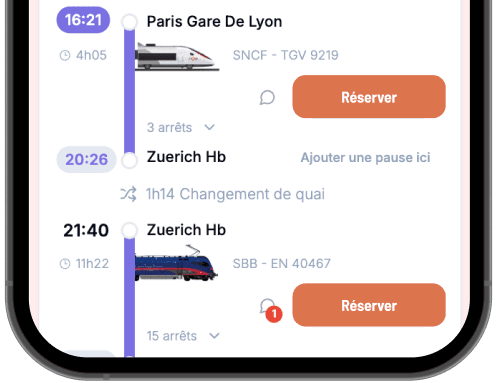
Another, more cinematic option: Paris → Zurich by TGV Lyria (about 4 hours), then a night train or daytime trains to Austria via Innsbruck and Villach. The route crosses the Swiss and Austrian Alps rather than Germany, for those who prefer scenery over speed.
Good to know: Some routes between Salzburg and Villach are affected by occasional renovation work on the Tauern Tunnel line, with replacement buses sometimes operating on certain sections—it’s best to check the most up-to-date schedules before booking.
Jesenice is primarily worth visiting for its industrial heritage. The historic district of Stara Sava, designated a national monument, traces the history of the local steel industry through several sites: the Iron and Steel Museum, housed in the Bucelleni-Ruard mansion, and the Kasarna building—a former workers’ dormitory converted into an ethnological museum—where visitors can even enjoy a traditional breakfast in an authentic steelworker’s apartment.
In the city center, the statue of the steelworker, standing in a roundabout, serves as a humorous and proud reminder of the the city's industrial identity e, just like the Church of Saint-Léonard, which has watched over the neighborhood since the 13th century.
For outdoor enthusiasts, Jesenice is also a starting point for the Golica Peak, at 1,836 m, known for its fields of wild daffodils that blanket the slopes in May and for the view it offers of the Julian Alps, the Karavanke Range, and as far as Triglav on clear days.
The Triglav National Park, the country's only national park, begins right on the outskirts of the city, as do the famous Vintgar Gorges—just about 20 minutes away—with their suspension bridges stretching over the turquoise waters of the Radovna River.
Jesenice is also a convenient base for exploring the entire Sava Valley without a car: Bled and its lake, Kranjska Gora and its ski slopes, as well as the small Alpine villages in the surrounding area—all accessible by train or a quick transfer from the station.
appCreate your train trip step by step and quickly find the best no-flight options.
Enrich this content and showcase how accessible your destination is by train, like our recent partners: , .