
Interrail, 6 mistakes you'll be happy to avoid
by
Published on 6/26/23, modified on 7/23/26

Inspiration and great deals for your next low-carbon trips



Do you dream of traveling across Europe by train, with a ticket in hand and no restrictions on your itinerary? The Interrail pass is perfect for you. Since 1972, this rail pass has provided access to a network of 33 European countries, from Norway to Portugal and from Ireland to Turkey, without having to book a ticket for each leg of the trip. In 2026, the lineup expanded to include the Plus Pass (including reservations), and there's even a version free for 18-year-olds through Erasmus+. In this guide, we'll help you choose the right pass, understand how to make reservations, and take advantage of a little-known tip—the famous approach route, to travel even more affordably.
What is the Interrail Pass? A travel pass offering unlimited or flexible access to trains in 33 European countries, for European residents.
How much does it cost? Starting at about €212 (youth) and €283 (adult) in second class for a 4-day trip within a 1-month period. Up to over €900 for 3 consecutive months.
Do I need to reserve a seat? Yes, on most high-speed trains (TGV, Frecciarossa, AVE...), for an additional 5 to 35 €, except with the new Interrail Plus Pass which includes these reservations.
Is there a free pass? Yes, the pass DiscoverEU (The Erasmus+ program) offers a free transit pass to 18-year-olds twice a year.
How can I leave France without paying for a reservation? Thanks to the Interrail Approach Route, a free fare to travel to the border by TGV.
The Interrail Pass is a ticket that provides access to the national rail networks of 33 European countries, managed by the Eurail Group. It covers, among others, Austria, Belgium, Bosnia, Bulgaria, Croatia, the Czech Republic, Denmark, Estonia, Finland, France, Germany, Great Britain, Greece, Hungary, Ireland, Italy, Latvia, Lithuania, Luxembourg, Montenegro, the Netherlands, North Macedonia, Norway, Poland, Portugal, Romania, Serbia, Slovakia, Slovenia, Spain, Sweden, Switzerland, and Turkey.
Only Russia, Ukraine, Albania, Moldova, and Morocco are not members.
No, not since 1998. The pass is available to anyone legally residing in Europe, with three price categories: Young (ages 12–27), Adult (ages 28–59) and Senior (Ages 60 and older). Children ages 4 to 11 travel for free with a Child Pass, up to two per paying adult, and children under 4 do not need a ticket.

A pass available to people of all ages!
None, except your place of residence. The Interrail Global Pass is the same product as the Eurail Pass—with the same branding, issued by the same Eurail Group G.I.E., on the same network, at the same prices and under the same terms and conditions. The only difference is eligibility: Interrail is reserved for European residents, Eurail for residents outside Europe. So if you live in France, you should definitely buy an Interrail pass.
There are two main types of passes: the Global Pass, valid in all 33 countries, and the One Country Pass, limited to a single country. Within the Global Pass, you can then choose between two travel options.
The Flexi Pass gives you a certain number of travel days to use over a period of 1 or 2 months (for example, 4, 5, 7, 10, or 15 days). Each day you use allows you to take as many trains as you want between 12:00 a.m. and 11:59 p.m. This is the ideal option if you’re traveling in stages with breaks of several days between cities.
The Continuous Pass, on the other hand, covers a fixed, uninterrupted period of 15 days to 3 months, during which you can travel without keeping track of the days. It's best suited for a tour of Europe where you change cities almost every day.
The prices below are for reference only, for second class, and should be verified on interrail.eu before purchase (they change throughout the year and are subject to regular flash sales!):
| Formula | Youth (ages 12–27) | Adult (ages 28–59) | Senior (age 60 and older) |
|---|---|---|---|
| Flexi 4 days / 1 month | ~€212 | ~€283 | ~255 € |
| 7-Day / 1-Month Flexi Pass | ~286 € | ~€381 | ~€343 |
| Flexi 10 Days / 2 Months | ~€335 | ~€447 | ~€402 |
| 15 consecutive days | ~357 € | ~€476 | ~€428 |
| 1-Month Continuous | ~€522 | ~€696 | ~€626 |
| Continuous for 3 months | ~717 € | ~€956 | ~€860 |
First-class tickets cost about 25 to 50 percent more, depending on the fare option.
A simple rule for figuring out if the pass is worth it: Compare its price to the total cost of individual tickets for all your planned trips. In practice, the more stops your itinerary has, the faster the total cost of individual tickets adds up, and the more likely the pass is to be the better deal.
If just one country is enough for you, the One Country Pass can end up being much cheaper. Be careful, though: for Greece, there’s a separate pass, the Greek Islands Pass, which does not cover trains but rather ferries operated by Blue Star Ferries and Hellenic Seaways (Attica Group), with routes to Crete operated jointly with Anek Lines. There are no inter-island rail connections in Greece. Expect to spend around 80–100 € for 4 days of ferry travel over the course of a month.
Launched as a beta version in 2026, the Interrail Plus Pass It covers your train travel as well as the cost of mandatory seat reservations on most high-speed, international, and regional trains in Europe, and also allows you to travel on and reserve a seat on night trains. In practical terms: you no longer need to pay a separate reservation fee on a Germany-France ICE or a Eurostar—these costs are included in the pass.
The Global Plus Pass operates on a reservation credit system. Most trains that can be reserved with this pass do not require any credits, but some—such as the Eurostar, the ICE between Germany and France, or the Eurocity between Switzerland and Italy—do require one. When you purchase the Global Plus Pass, you receive 3 reservation credits, as well as one day for the outbound trip and one day for the return trip to and from your country of residence.
This pass is particularly useful if your itinerary takes you through Austria, Belgium, Germany, Italy, Spain, Sweden, or Switzerland, where booking trains operated by ÖBB, SNCB, Trenitalia, RENFE, SJ, or SBB requires no additional credit. If your trip takes you outside this list of countries, a standard Global Pass is still the simplest option.

If you're 18, you can definitely get an Interrail pass free. DiscoverEU, an initiative under the Erasmus+ program, provides travel vouchers to selected young people to explore the EU and countries associated with Erasmus+, with the option to travel in a group of friends as long as everyone meets the eligibility requirements.
Winners can travel for up to 7 days over a one-month period (at any time between July 1, 2026, and September 30, 2027), and receive a European Youth Card as a bonus, which provides access to discounts on cultural attractions, activities, local transportation, lodging, and food. Applications open twice a year (April and October) on the European Youth Portal. To apply, you must be in the correct age group and reside in an EU member country or a country associated with Erasmus+ (Iceland, Liechtenstein, North Macedonia, Norway, Serbia, Turkey). There’s no guarantee you’ll win—it’s a random drawing from among the applicants. But it’s always worth trying your luck!
Our best train deals, straight to your inbox
Please note: Just because you have an Interrail pass doesn't mean you can board any train without anything else. On high-speed trains and certain night trains, a seat reservation remains mandatory, in addition to the pass.
Almost all of Europe's high-speed rail lines require a paid reservation: the TGV in France, the Eurostar between London and the continent, the Frecciarossa and Frecciargento in Italy, the AVE and Iryo in Spain, and the Swedish high-speed trains. Here are some examples of surcharges to expect:
| Train | Reservations are required |
|---|---|
| TGV | €9 to €35 |
| Eurostar | €15 to €35 |
| Frecciarossa / Frecciargento | 13 € |
| Frecciabianca | 10 € |
| EIP (Poland) | 10 € |
| AVE (Spain) | €10 to €24 |
| Iryo (Spain) | €10–13 |
| Swedish high-speed trains (SJ 2000 & 3000) | €7 to €17 |
More info here.
Conversely, In much of Germany, Austria, Switzerland, and the Benelux countries, most trains operate without a mandatory reservation : You get on, you travel, and that's it!
Everything is handled through the app Rail Planner, the official Interrail app: you can activate your pass, search for your routes, see if a reservation is required, and book it directly online. The app also offers a “no reservation required” filter: it’s convenient, but it might extend your travel time by directing you to slower trains or those with more transfers.

© Interrail
Almost. With the Interrail Plus Pass, reservations are included on most of the trains listed above, with no additional fee to pay out of pocket when you book. The only exceptions are: reservations for sleeper berths on night trains (which are still charged at the standard rate), tickets that must be purchased as paper tickets, and trains not listed in the official timetable. Also keep in mind ferries and buses: they’re never included in your booking credits, but you can get discount codes for them through Interrail’s Pass Benefits portal.

Article
Travelling Europe by train: the best tips for travelling with Interrail
This is the least well-known tip for the Interrail Pass, and yet one of the most useful for French residents.
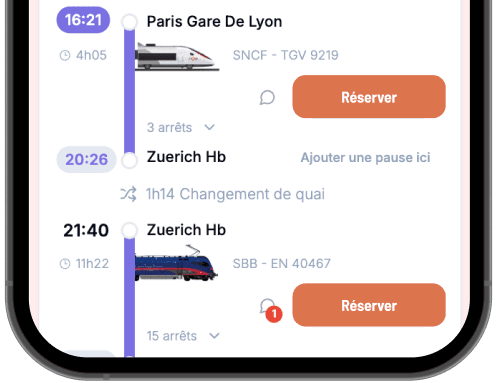
With a Global Pass, you’re entitled to one round-trip journey within your country of residence to reach or leave an international border station. In France, this journey allows you to travel for free on the TGV to a station with an international rail connection (for example, from Rennes to Lyon), before taking a high-speed train to Barcelona or Milan. The same applies for the return trip.
You have to go to a SNCF ticket office and specifically ask for the “Interrail approach route.” Please note that reservations by phone at 3635 have not been available since October 2025, so it’s best to plan a visit to the station. And that’s where things get tricky: many SNCF agents are unfamiliar with this fare. Two internal codes can help resolve the issue: IR00 for a purely domestic trip (Besançon to Paris, for example) and IR50 for an international trip departing from France. Don't hesitate to mention them if the agent seems unsure! More info here.
Yes, here are three things you should know before heading to the station:
The real joy of an Interrail pass is the freedom to create a personalized itinerary rather than a standard round-trip.

Article
Interrail: 31,000 km, 27 countries and over 200 trains, Luc's incredible journey
Let’s look at a concrete example of a 7-day trip using a Flexi Pass Global:
- Paris to Lyon by TGV (Day 1)
- 3 nights in Lyon, then Lyon to Milan by Frecciarossa (Day 2),
- 2 nights in Milan,
- Milan to Zurich by Eurocity (Day 3),
- Return via a direct route.
Each leg of the trip takes one day, and you're free to stay for one or more nights between legs: that's the whole point of the Flexi Pass compared to a simple round trip.
Article
Travelling Europe by train: the best tips for travelling with Interrail

Article
Traveling in Scandinavia: Alice tells us about her Interrail trip
If the Greek archipelago appeals to you, keep in mind that travel between the islands is by ferry, not by train (see the Greek Islands Pass mentioned above): combine it with the Global Pass rather than using it as a substitute if your itinerary also includes the mainland.
It all starts, once again, with the app Rail Planner : It works offline once the schedules have been downloaded, generates your daily ticket, and alerts you to any required reservations. Also, remember to activate your pass at the right time: you can purchase a mobile pass up to 11 months before departure, with no fixed date at the time of purchase—you choose your first day of travel when you activate it.

© Interrail
Some routes are worth taking just for their own sake, not just for the destination: the Bernina Express between Chur and Tirano in Switzerland, a UNESCO World Heritage Site; the line from Flåm in Norway, one of the steepest in Europe, winding through fjords and mountains; or the crossing of the Cinque Terre In Italy, it is fully covered by the pass. In France, the Maurienne line to Chamonix or Modane leads directly to the Italian Alps.
The night trains let you save on a night's hotel stay while continuing on your itinerary. This is an option worth seriously considering on long trips like Brussels to Berlin on the ÖBB Nightjet, or Stockholm to Narvik in Scandinavia. With the Interrail Plus Pass, you can reserve a seat on these night trains. But keep in mind that for a real sleeper berth, you’ll have to pay the standard fare, whether you have a pass or not.

Article
Night Trains in France and Europe: A Complete Guide
In 2026, the Interrail Pass remains one of the simplest and most borderless ways to travel by train across Europe: a single ticket, 33 countries, and true freedom to plan your own itinerary. Between the classic Global Pass, the new Plus Pass that includes reservations, and the free DiscoverEU Pass for 18-year-olds, there’s an option for (almost) every budget and every age group. All you have to do is choose your pass type, set up your connecting trip if you’re departing from France, and let the Rail Planner do the rest.
Just a heads-up before you book your pass: The Interrail option isn't always the cheapest option. It all depends on your itinerary, the number of stops, and any reservations you need to make. Before you get started, we recommend comparing it with an itinerary planned trip by trip.
That's exactly what our train trip planner (free) : Plan any itinerary in Europe with just a few clicks—whether you have a pass or not—and instantly find the best option for your trip.
And by joining the HOURRAIL Club!, you also get access to the Premium version of our app (which includes authentic feedback from the community), but most importantly, you unlock exclusive benefits Exclusive to members—save money on your tickets and accommodations!

Article
The HOURRAIL Club: the community for low-carbon travel and slow travel
Issue du monde de la communication et des médias, Sophie est Responsable éditoriale chez HOURRAIL ! depuis août 2024. Elle est notamment derrière le contenu éditorial du site ainsi que La Locomissive (de l'inspiration voyage bas carbone et des bons plans, un jeudi sur deux, gratuitement dans ta boîte mail !).
Convaincue que les changements d’habitude passent par la transformation de nos imaginaires, elle s’attache à montrer qu’il est possible de voyager autrement, de manière plus consciente, plus lente et plus joyeuse. Son objectif : rendre le slow travel accessible à toutes et tous, à travers des astuces, des décryptages et surtout, de nouveaux récits.


